

Nabla
Founded Year
2018Stage
Series C | AliveTotal Raised
$114.26MLast Raised
$70M | 5 mos agoRevenue
$0000Mosaic Score The Mosaic Score is an algorithm that measures the overall financial health and market potential of private companies.
+63 points in the past 30 days
About Nabla
Nabla provides ambient artificial intelligence (AI) technology focused on healthcare documentation and workflow efficiency. The company offers an AI assistant that generates clinical notes in real-time, integrated into electronic health records (EHRs), to address clinician workload and patient care. Nabla's solutions support various medical specialties and can be customized for different clinical needs. It was founded in 2018 and is based in Paris, France.
Loading...
Nabla's Product Videos

ESPs containing Nabla
The ESP matrix leverages data and analyst insight to identify and rank leading companies in a given technology landscape.
The clinical documentation solutions market includes companies leveraging technologies to streamline and improve the process of capturing, organizing, and using patient information. It includes solutions such as ambient documentation platforms that can document patient-clinician interactions, extract relevant medical information, and integrate with electronic health record (EHR) systems. Uses case…
Nabla named as Challenger among 15 other companies, including Microsoft, Oracle, and Amazon.
Loading...
Research containing Nabla
Get data-driven expert analysis from the CB Insights Intelligence Unit.
CB Insights Intelligence Analysts have mentioned Nabla in 9 CB Insights research briefs, most recently on Oct 20, 2025.
Oct 20, 2025 report
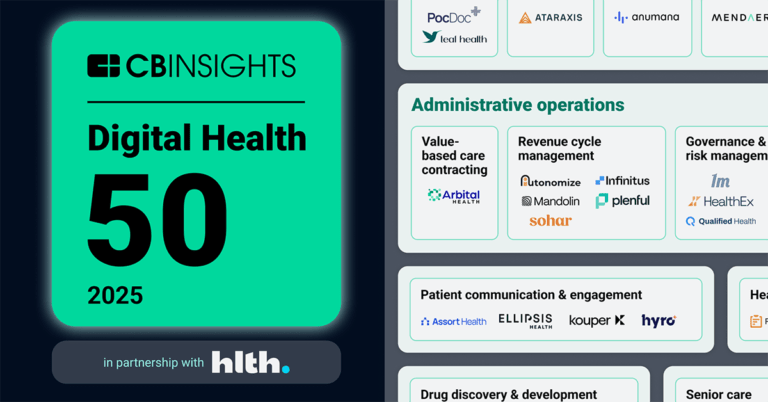
Digital Health 50: The most promising digital health startups of 2025
Aug 22, 2025 report
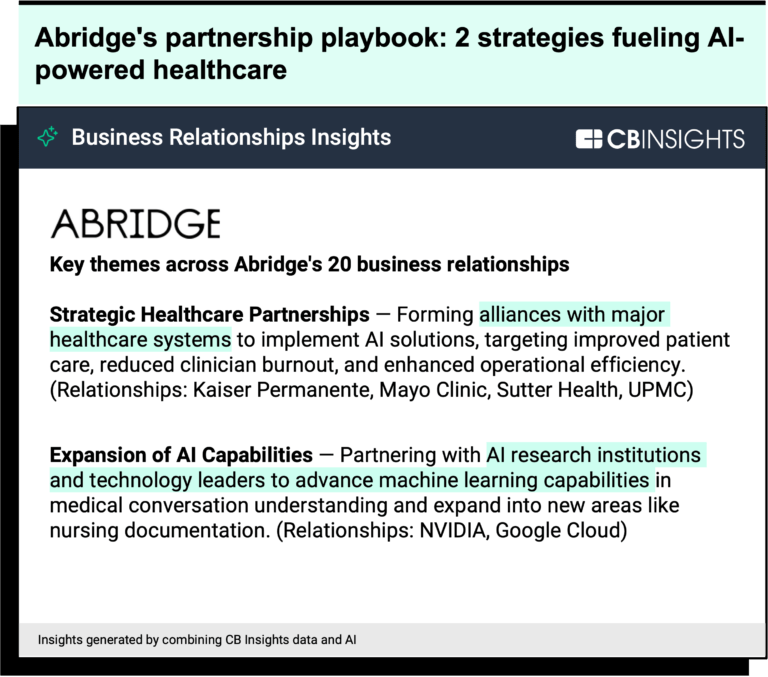
Book of Scouting Reports: Generative AI in Healthcare & Life Sciences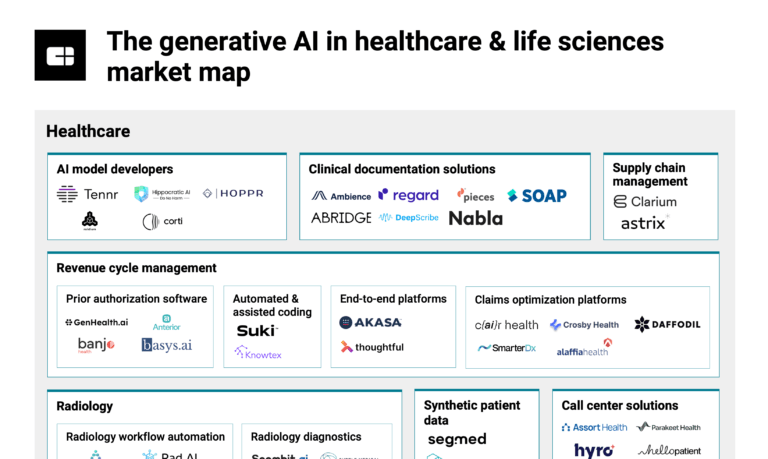
Jan 11, 2024
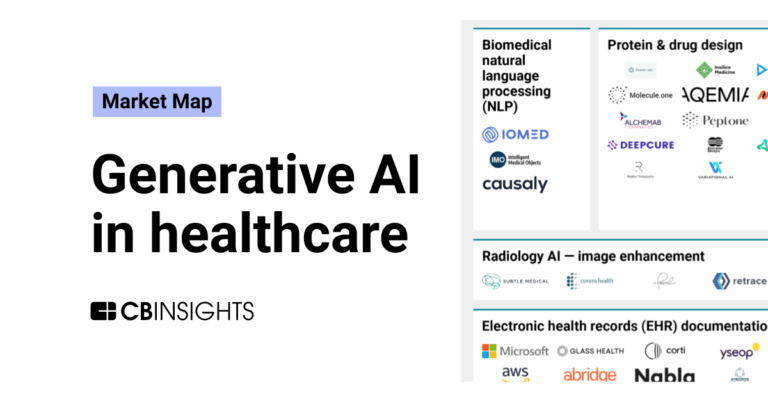
The generative AI in healthcare market map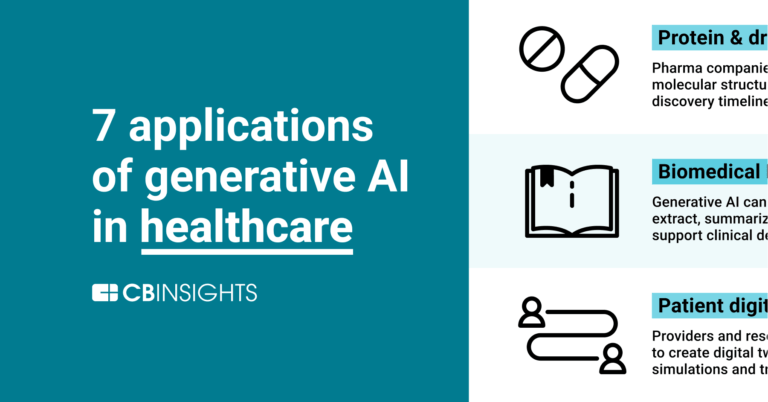
May 9, 2023
7 applications of generative AI in healthcareMay 9, 2023
7 applications of generative AI in healthcareExpert Collections containing Nabla
Expert Collections are analyst-curated lists that highlight the companies you need to know in the most important technology spaces.
Nabla is included in 6 Expert Collections, including Artificial Intelligence (AI).
Artificial Intelligence (AI)
16,578 items
Companies developing artificial intelligence solutions, including cross-industry applications, industry-specific products, and AI infrastructure solutions.
Digital Health
12,122 items
The digital health collection includes vendors developing software, platforms, sensor & robotic hardware, health data infrastructure, and tech-enabled services in healthcare. The list excludes pureplay pharma/biopharma, sequencing instruments, gene editing, and assistive tech.
Generative AI
2,951 items
Companies working on generative AI applications and infrastructure.
AI Agents & Copilots Market Map (August 2024)
322 items
Corresponds to the Enterprise AI Agents & Copilots Market Map: https://app.cbinsights.com/research/enterprise-ai-agents-copilots-market-map/
HLTH 2025 Exhibitors
878 items
A look at the HLTH Vegas 2025 exhibitor list we’ve been building so your team can start scanning for relevant companies.
Digital Health 50
50 items
Latest Nabla News
Oct 30, 2025
with agentic AI How ambient AI assistants are supporting clinicians to save time, reduce burnout, and enhance treatment, restoring the doctor-patient experience. For many clinicians, administration is a whole job on its own. From examination findings to proposed treatments, test results, and patient education, clinicians must maintain accurate, clear, and timely clinical records every step of the way. And the burden is getting heavier. Complex billing requirements and ever-changing regulations demand extensive documentation. And systems for electronic health records (EHR) are often unintuitive and inefficient, with complicated workflows that slow the process. This administrative load occupies at least eight hours of a US physician’s 59-hour work week, according to the American Medical Association (AMA), with many spending more than eight hours on electronic medical records outside working hours. This all contributes to burnout, which affects nearly half of US physicians . But ambient AI assistants are already offering a means of simplifying workflows, expediting patient records, and improving the overall efficiency of the health care system, with agentic AI poised to take on more of the administrative burden in the future. This is transforming the way clinicians spend their time and increasing their opportunities to engage meaningfully with patients. “I didn’t go to medical school to be a scribe. There should be technology that can do this task for me,” says Dr. Ed Lee, practicing physician and chief medical officer at health care AI company Nabla, which launched its first ambient AI assistant in 2023, now used by hundreds of health care organizations in the US. Nearly 0% of physicians in the US suffer from burnout Source: Compiled by MIT Technology Review Insights, based on data from AMA , 2025 Letting doctors be doctorsbe doctors Current ambient AI assistants, which gained mainstream traction in 2023, are already able to record, structure, and summarize patient encounters in real time. This liberates clinicians from the time-consuming exercise of writing notes, allowing them to fully engage with their patients. “For complex patients, it could take me up to 45 minutes to complete the documentation. Nabla makes that task infinitely better and allows me to give each patient my full, undivided attention. At the end of the visit, I click, and Nabla produces a thoughtfully crafted, concise record of what happened,” says Lee, who puts the accuracy of Nabla’s system in the “high 90s” in terms of percentage, with the clinician always responsible for reviewing and signing off on the final record. “For complex patients, it could take me up to 45 minutes to complete the documentation. Nabla makes that task infinitely better and allows me to give each patient my full, undivided attention. At the end of the visit, I click, and Nabla produces a thoughtfully crafted, concise record of what happened.” Dr. Ed Lee, Chief Medical Officer, Nabla This kind of uninterrupted patient engagement can lead to better eye contact and a higher quality interaction. For instance, clinicians tend to verbalize their thought process more when there is alternative notetaking during a patient evaluation. “We originally thought that patients would be worried about an AI device listening, but actually they are very excited,” says Alexandre LeBrun, co-founder and chief executive officer of Nabla. “They get the full attention of their physician during the visit, and they love when they hear technical language as they sense they get better care.” According to LeBrun, Nabla’s system can further support clinicians by automating pre-charting, reviewing and organizing a patient’s information in their EHR before an appointment, and coding medical data for use in areas like billing. Nabla has also expanded its platform with a built-in dictation capability, bringing clinicians closer to a unified experience. These kinds of AI assistant tasks can help to streamline and enhance clinical workflows and contribute to a reduction in institutional administrative costs. The promise of agentic AIagentic AI Agentic AI, which companies like Nabla are currently working to integrate into their systems, promises to take the success of existing AI assistants a step further. LeBrun is looking to a future in which clinicians interact with an agentic platform that links to all the tools they already use and simplifies multi-step interactions, like reading patient data, acting within the EHR, and adapting to workflows in real time. “Rather than forcing doctors and nurses to click through a dozen separate systems, our platform will provide specialized, customizable, and composable agents that turn disconnected tools into a single, continuous workflow,” LeBrun says. “Imagine a cardiologist getting ready for their morning clinic. After a few voice commands to instruct the system, one agent pulls the latest vitals, lab results, and imaging reports from the EHR, another generates a clear patient summary, and a third flags a missed follow-up echocardiogram. All before the patient even walks into the room,” LeBrun explains. “Rather than forcing doctors and nurses to click through a dozen separate systems, our platform will provide specialized, customizable, and composable AI agents that turn disconnected tools into a single, continuous workflow.” Alexandre LeBrun, Co-founder and Chief Executive Officer, Nabla Lee says that agentic AI’s near-term scope includes standardized and protocolized non-clinical tasks, but he sees promise in areas like treatment options and other types of clinical decision support, where AI can safely operate with clinicians always “in the loop.” To get to this point, education is essential, says Lee. “The beauty of medicine is that it’s a lifelong learning process. It’s not just learning about the science behind medications, diagnoses, and treatments; it’s about adapting to the use of new tools that will ultimately improve the care of the patients you treat,” he explains. “We need to start with the basics of AI, making sure everyone understands what it is and how it works. Not how the programming takes place but more around what it can do, what it can’t do, the risks and pitfalls, and then really understanding where it fits best in the care of patients,” says Lee. Leadership must look ahead strategically and ensure the entire organization is moving forward with its use and understanding of AI, he adds. “Part of that journey is involving frontline users to be part of the process, co-designing whenever possible and conducting pilots of new solutions so the organization can learn,” Lee says. Additionally, “a culture of inclusivity, authenticity, and transparency needs to be in place so you can be in the best position to be successful with transformative efforts such as incorporating and integrating agentic AI into the ecosystem,” he says. “Part of that journey is involving frontline users to be part of the process, co-designing whenever possible and conducting pilots of new solutions so the organization can learn.” Dr. Ed Lee, Chief Medical Officer, Nabla Safely integrating into workflowsinto workflows Applying AI to high-stakes sectors like health care requires a careful balance between productivity on the one hand, and accuracy on the other. “Trust is everything in medicine,” says LeBrun. “Earning that trust means giving clinicians confidence through accuracy, transparency, and respect for their expertise.” Nabla uses techniques like adversarial training models to check outputs, and it defaults to conservative responses. “We optimize precision. If we have a slight doubt, we prefer to remove something from the output by default,” says LeBrun “Trust is everything in medicine. Earning that trust means giving clinicians confidence through accuracy, transparency, and respect for their expertise.” Alexandre LeBrun, Co-founder and Chief Executive Officer, Nabla New tools must also interweave with existing workflows and platforms to avoid adding more complexity for clinicians. “Any product can look great, but if it doesn’t fit well into your existing workflows, it’s almost useless,” says LeBrun. In sectors like customer service, it is straightforward to build a new interface or platform, but that approach isn’t feasible—or desirable—in health care. “It's a complex network of dependencies with so many workflows and processes,” says LeBrun. “Everybody would like to get rid of these things, but it's not possible because you would need to change everything at once.” Agentic AI approaches offer great promise to sectors like health care because they can “improve the process without getting rid of the legacy infrastructure,“ LeBrun explains. By simplifying complex systems, automating routine tasks, and continuing to take on more of the time-consuming burden of administrative work, agentic AI holds great promise in further augmenting ambient AI assistants. Ultimately, the technology’s potential is not in making medical decisions or replacing clinicians, but in supporting health care workers to dedicate more of their time and attention to their main priority: their patients. “AI should focus on supporting decisions and automating everything downstream,” says LeBrun. “The first role of AI is to get physicians back to the state where they make medical decisions.” Discover more insights from Nabla here . This content was produced by Insights, the custom content arm of MIT Technology Review. It was not written by MIT Technology Review’s editorial staff. This content was researched, designed, and written by human writers, editors, analysts, and illustrators. This includes the writing of surveys and collection of data for surveys. AI tools that may have been used were limited to secondary production processes that passed thorough human review.
Nabla Frequently Asked Questions (FAQ)
When was Nabla founded?
Nabla was founded in 2018.
Where is Nabla's headquarters?
Nabla's headquarters is located at 22 Rue Chapon, Paris.
What is Nabla's latest funding round?
Nabla's latest funding round is Series C.
How much did Nabla raise?
Nabla raised a total of $114.26M.
Who are the investors of Nabla?
Investors of Nabla include Cathay Innovation, DST Global, Build Collective, HV Capital, Highland Europe and 6 more.
Who are Nabla's competitors?
Competitors of Nabla include Pieces, Ambience, Iodine Software, Tandem, Abridge and 7 more.
Loading...
Compare Nabla to Competitors

Abridge focuses on generative artificial intelligence (AI) for clinical conversations within the healthcare sector. The company provides AI solutions that create AI-generated notes intended for use in patient-clinician interactions. It serves healthcare systems, intending to enhance clinician efficiency and nursing documentation. Abridge was formerly known as Intelligible.AI. It was founded in 2018 and is based in Philadelphia, Pennsylvania.

Ambience operates as a healthcare technology company that provides ambient artificial intelligence (AI) solutions for clinical documentation, coding, and patient summaries. The company has a platform that integrates with electronic health records (EHRs) to support patient care, specialty workflows, documentation accuracy, and billing processes. Ambience serves the healthcare sector with tools aimed at addressing clinician burnout. It was founded in 2020 and is based in San Francisco, California.
Heidi Health provides AI-driven healthcare solutions within the medical technology sector. The company offers an AI scribe that assists clinicians by capturing clinical notes, generating summaries, and facilitating follow-ups during patient consults. Heidi Health's products aim to reduce administrative tasks for healthcare professionals. It was founded in 2019 and is based in Cremorne, Australia.

DeepScribe automates medical documentation through its platform in the healthcare sector. It provides a medical scribe that captures patient conversations and generates clinical notes, as well as coding support and note personalization for clinicians. It serves the healthcare industry, focusing on specialty care and value-based care. It was founded in 2017 and is based in San Francisco, California.

Augmedix is a company that specializes in ambient AI solutions for medical documentation. The company provides services to capture and convert clinician-patient conversations into structured medical notes. Augmedix serves the healthcare sector, collaborating with hospitals and health systems to improve clinical workflows and data management. It was founded in 2012 and is based in San Francisco, California.

Beam Health focuses on healthcare technology, providing AI-based solutions for medical documentation. Its main product, Shine AI, automates the clinical documentation process by listening to consultations, transcribing them, and generating clinical notes that integrate with electronic medical records (EMR) systems. Its offerings are targeted at healthcare providers. It was founded in 2020 and is based in Red Bank, New Jersey.
Loading...