
Thymia
Founded Year
2020Stage
Seed VC - II | AliveTotal Raised
$3.8MLast Raised
$2.7M | 2 yrs agoMosaic Score The Mosaic Score is an algorithm that measures the overall financial health and market potential of private companies.
-154 points in the past 30 days
About Thymia
Thymia specializes in mental health technology, providing AI-powered assessments to objectively measure and monitor mental health conditions. The company offers tools that leverage machine learning and neuropsychology to accurately identify mental illness symptoms using a unique combination of voice, video, and behavioral data. Thymia primarily serves healthcare providers, payers, and employers with its mental health evaluation and monitoring solutions. It was founded in 2020 and is based in London, United Kingdom.
Loading...
ESPs containing Thymia
The ESP matrix leverages data and analyst insight to identify and rank leading companies in a given technology landscape.
The mental health voice biomarkers market offers solutions to diagnose mental issues by monitoring changes in speech patterns. These companies use machine learning to analyze vocal patterns to detect changes in a person’s mood, emotion, and mental state over time, providing clinicians with data for more precise and accurate diagnoses. The market also aims to improve patient outcomes, reduce health…
Thymia named as Challenger among 9 other companies, including Sonde Health, Ellipsis Health, and Canary Speech.
Thymia's Products & Differentiators
Thymia Virtual Clinic
.....
Loading...
Research containing Thymia
Get data-driven expert analysis from the CB Insights Intelligence Unit.
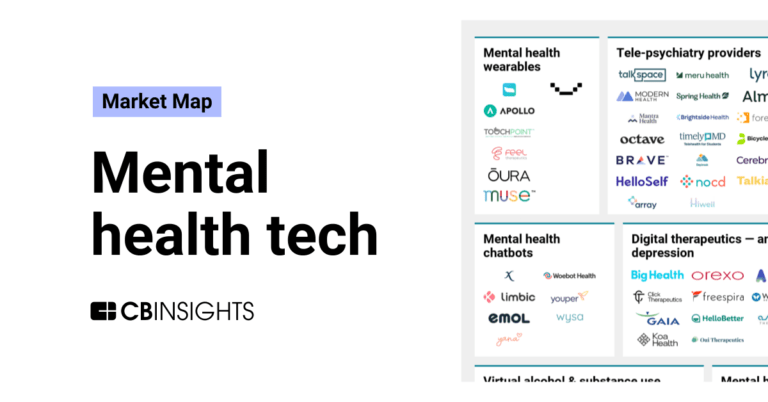
CB Insights Intelligence Analysts have mentioned Thymia in 1 CB Insights research brief, most recently on Sep 13, 2023.
Sep 13, 2023
The mental health tech market mapExpert Collections containing Thymia
Expert Collections are analyst-curated lists that highlight the companies you need to know in the most important technology spaces.
Thymia is included in 5 Expert Collections, including Artificial Intelligence (AI).
Artificial Intelligence (AI)
16,578 items
Companies developing artificial intelligence solutions, including cross-industry applications, industry-specific products, and AI infrastructure solutions.
Value-Based Care & Population Health
893 items
The VBC & Population Health collection includes companies that enable and deliver care models that address the health needs for defining populations along the continuum of care, including in the community setting, through participation, engagement, and targeted interventions.
Digital Health
12,122 items
The digital health collection includes vendors developing software, platforms, sensor & robotic hardware, health data infrastructure, and tech-enabled services in healthcare. The list excludes pureplay pharma/biopharma, sequencing instruments, gene editing, and assistive tech.
Telehealth
3,123 items
Companies developing, offering, or using electronic and telecommunication technologies to facilitate the delivery of health & wellness services from a distance. *Columns updated as regularly as possible; priority given to companies with the most and/or most recent funding.
Mental Health Tech
791 items
This collection includes companies applying technology to problems of emotional, psychological, and social well-being. Examples include companies working in areas such as substance abuse, eating disorders, stress reduction, depression, PTSD, and anxiety.
Latest Thymia News
Jun 19, 2024
17 years on from the country’s devastating debt crisis, Greece’s tech and startup ecosystem is maturing. We hear from four Greek founders on what it’s been like scaling up 6 min read Life has indeed become easier — in some respects — for Greek founders. A more established ecosystem means more people to bounce ideas off, and more support in the form of government programmes, EU funding and VC dollars. Entrepreneurs coming back to Greece after stints in Europe or the Americas have also created a global network for founders to tap into. According to Endeavor Greece, the Greek tech ecosystem consists of over a thousand startups that have a combined value of more than $12bn. Still, Greek founders have had to contend with a dip in funding, a brain drain and the aftermath of a devastating debt crisis. Advertisement Konstantinos Kyriakopoulos, cofounder and CEO of DeepSea Technologies Kyriakopoulos left Greece at 17 to study in the UK. He cofounded DeepSea Technologies, a maritime tech company that uses AI to make ships more efficient, in 2017. The company was acquired by the Japanese multinational Nabtesco in 2023. “In the beginning, I ran the company from Cambridge but I moved back to Greece permanently in 2020. We set up here because we believed most of our customers would be in Greece, and we thought the talent would be cheap. Both assumptions turned out not to be true. Most of our revenue actually comes from Norway, Singapore, Germany and Ireland, although we do also have a lot of customers in Greece. Greece is a talent hub for shipping related industries and there are very few places where you can find that knowledge combined with technical expertise. We have found really good people here — there’s a great neural network department at the Technical University of Crete. But if you’re hiring really talented people, there is an international rate for it. Greece is a talent hub for shipping-related industries and there are very few places where you can find that knowledge combined with technical expertise. Our competitors in the US, for example, fail because they don’t understand the customers and they don’t understand the market. Everyone we’ve hired has some connection with the sea.” Emilia Molimpakis, CEO and cofounder of thymia Molimpakis grew up in Greece but left at 21 to study in the UK. In 2020, she cofounded thymia, an online platform that accurately and objectively assesses mental health issues, starting with depression. The startup has since raised a £2.7m seed round, led by Kodori Ventures, and a further £1.1m via Crowdcube. “We’re based in the UK but we do serve clients globally, including Europe, Canada, Latin America, India and the US. We’re currently working with companies in Greece who offer mental wellness assessments to their employees but we need to get more strongly embedded with the healthcare system before we’ll set up an outpost there. University is so difficult to get through that it creates high perseverance and really strong entrepreneurs, by default. We were studying maths and science at high school that is covered during the first year of university in the UK. There’s a lot of talent. When we spoke to the Greek VCs, we had outgrown them very quickly, even at pre-seed. The tech ecosystem is evolving and growing quite rapidly, compared to a few years ago. But to be honest, I don’t think the funding in Greece is going fast enough to enable startups to grow at the speed they need. Plus the valuations are really low. When we spoke to the Greek VCs, we had outgrown them very quickly, even at pre-seed. The valuations were half what they were elsewhere.” George Chatzigeorgiou, CEO and cofounder of Skroutz Chatzigeorgiou founded Skroutz in Athens in 2005. The online marketplace is the fourth most visited site in Greece, and has plans to expand into Romania, Bulgaria and the wider Balkans. In 2020, CVC Capital Partners invested an undisclosed amount. “I’m an engineer, not an entrepreneur. But I was passionate about creating things. Starting Skroutz was almost accidental. We had no business plan and there weren’t really any VCs, or ways to get funding. We built the company slowly, just focusing on the product. After four or five years, we realised we could no longer afford to be the geeks in front of the computer. We started behaving like it was a real business in 2009. Greece is a bit of a favourite child of Europe right now, which is odd because we’ve gone from the most hated to one that has potential. During the financial crisis, Greece wasn’t a good place to be. We were lucky enough not to be directly affected but no one knew what was going to happen the next day and a lot of people left the country. We started to see signs of people returning in 2018 and during the pandemic. We have benefitted from their international experience, hiring people from Deliveroo, Google, Spotify and Shopify. This helps the ecosystem a lot. Advertisement Greece is a bit of a favourite child of Europe right now, which is odd because we’ve gone from the most hated to one that has potential.” Maria Dunford Founder and CEO, Lifebit Biotech Ltd Dunford founded Lifebit Biotech Ltd in the UK in 2017. The company, which democratises access to biomedical data, has a team of 150 people across Europe, Singapore and the US. In 2021, Lifebit raised $60m in a Series B round, led by Tiger Global. “The typical joke about Greece is that the main thing we export is smart people. Every Greek family puts a big emphasis on education, so 90% of the population has higher education. It’s very unique in that way, and that creates a good work ethic. The challenge is that Greece is a very bureaucratic country. A lot of the logistics of setting up a company have been difficult to manage but the current government is really pushing to simplify that process. It can be hard to find experienced talent in Greece, particularly in our field. There’s nowhere they can get experience and startups can’t afford to train them for two years — we’re just too small. That means these very bright young people have to leave the country. Our office in Athens has 25 people who are front- and back-end engineers, operational people, marketing and sales. They’re not in specialised roles — we have to hire those people from Cambridge, Oxford or a London-based institution. It can be hard to find experienced talent in Greece, particularly in our field. Our big goal for this year is to expand so that our data network represents half a billion patients across the world. That will include expanding the software capability needed to handle and analyse this data. We’ll be relying on our Greek team to achieve that, and expanding the Athens office further to meet those objectives.” For more on Greece’s tech scene, including the top scaleups in the country to watch, take a look at Sifted’s new report, Greeking out 2.0 , sponsored by Endeavor Greece. Advertisement
Thymia Frequently Asked Questions (FAQ)
When was Thymia founded?
Thymia was founded in 2020.
Where is Thymia's headquarters?
Thymia's headquarters is located at International House, London.
What is Thymia's latest funding round?
Thymia's latest funding round is Seed VC - II.
How much did Thymia raise?
Thymia raised a total of $3.8M.
Who are the investors of Thymia?
Investors of Thymia include Form Ventures, Kodori, Entrepreneur First, Calm/Storm Ventures, Crowdcube and 7 more.
Who are Thymia's competitors?
Competitors of Thymia include Ellipsis Health, Psyomics, Deliberate AI, Kintsugi, Psyrin and 7 more.
What products does Thymia offer?
Thymia's products include Thymia Virtual Clinic.
Loading...
Compare Thymia to Competitors

Kintsugi focuses on mental health care within the healthcare industry. The company offers an application programming interface (API)-first platform that uses voice biomarker technology to identify and prioritize mental health challenges, integrating with various healthcare systems to facilitate timely care. Kintsugi primarily serves the healthcare sector, providing tools for telehealth, call centers, and remote patient monitoring. It was founded in 2019 and is based in Berkeley, California.

Ellipsis Health provides health case management solutions using machine learning within the healthcare sector. It was founded in 2017 and is based in San Francisco, California.
Videra Health specializes in AI-based patient assessment and monitoring within the healthcare sector. The company offers a platform that analyzes facial expressions, language, and voice patterns to screen and monitor patients for behavioral health conditions. Videra Health primarily serves sectors such as behavioral health, payors & ACOs, pharmaceutical & life sciences, and providers. It was founded in 2019 and is based in Orem, Utah.

Sonde Health specializes in health technology and focuses on voice-enabled symptom detection and monitoring within the healthcare sector. The company offers a platform that analyzes vocal features to assess mental, cognitive, and respiratory health, providing actionable insights for early detection and management of health conditions. It was founded in 2015 and is based in Boston, Massachusetts.

Modality.AI is a company that assesses neurological and psychiatric conditions using a multimodal platform in the clinical research sector. The company provides automated analysis of speech, facial expressions, and motor functions for clinical trials, both in-clinic and remotely, without requiring specialized equipment or personnel. Modality.AI serves the pharmaceutical and biotechnology industries by offering tools for clinical assessments. It was founded in 2018 and is based in San Francisco, California.

OPTT Health provides behavioral health analytics within the mental health care sector. The company offers digital mental health tools that analyze patient narratives to provide insights for mental health providers, aiding in triage, personalized treatment pathways, and continuous patient monitoring. Its solutions aim to improve mental health care by utilizing algorithms. The company was founded in 2018 and is based in Toronto, Canada.
Loading...