

Simbian
Founded Year
2023Stage
Seed VC - II | AliveTotal Raised
$10.5MMosaic Score The Mosaic Score is an algorithm that measures the overall financial health and market potential of private companies.
+102 points in the past 30 days
About Simbian
Simbian focuses on autonomous AI agents for the cybersecurity domain, specifically for Managed Security Service Providers (MSSPs) and Managed Detection and Response (MDR) teams. Their offerings include AI agents that triage, investigate, and respond to security alerts, conduct threat hunts, and manage vulnerabilities, aimed at enhancing security. Simbian's solutions integrate with a range of enterprise and security tools, providing coverage and support for security teams. It was founded in 2023 and is based in Mountain View, California.
Loading...
ESPs containing Simbian
The ESP matrix leverages data and analyst insight to identify and rank leading companies in a given technology landscape.
The security operations center (SOC) AI agents & copilots market provides AI-powered solutions that enhance cybersecurity analysts' response and threat detection capabilities within security operations centers. These solutions range from autonomous AI agents that independently investigate alerts and take bounded actions to AI copilots that assist analysts through guided workflows and recommendatio…
Simbian named as Challenger among 15 other companies, including Tines, Blink, and Torq.
Loading...
Research containing Simbian
Get data-driven expert analysis from the CB Insights Intelligence Unit.
CB Insights Intelligence Analysts have mentioned Simbian in 3 CB Insights research briefs, most recently on Aug 22, 2025.
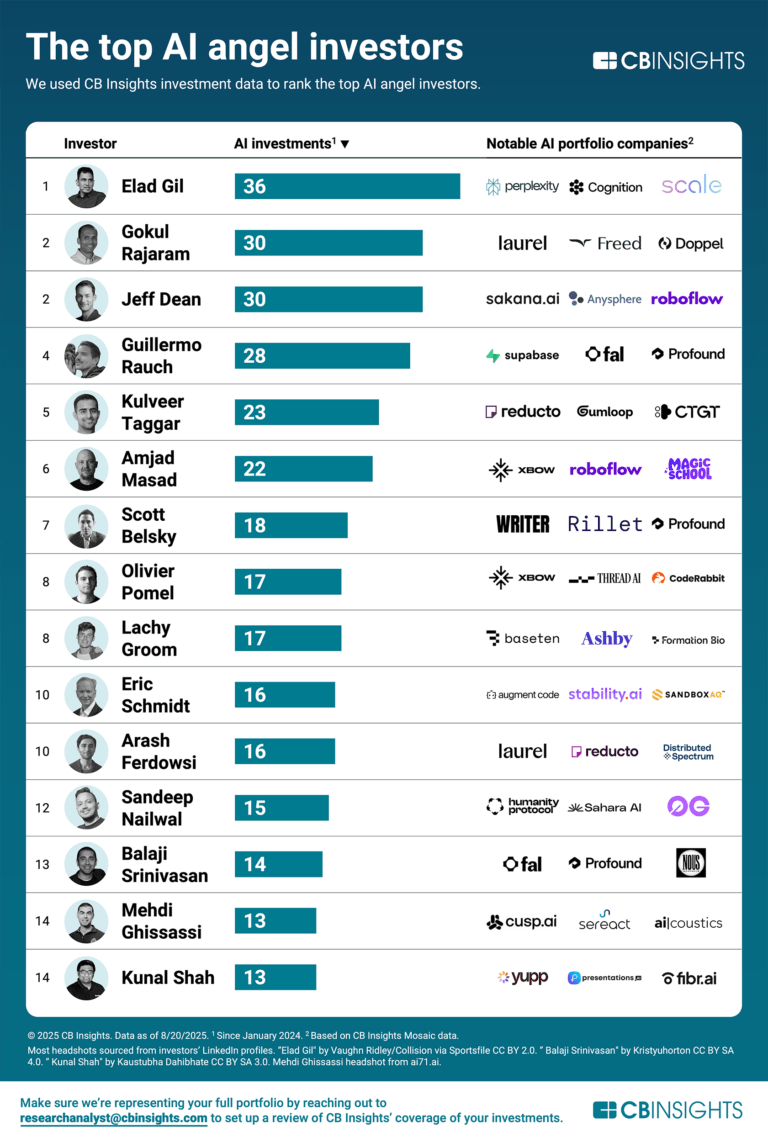
Aug 22, 2025
The top angel investors in AI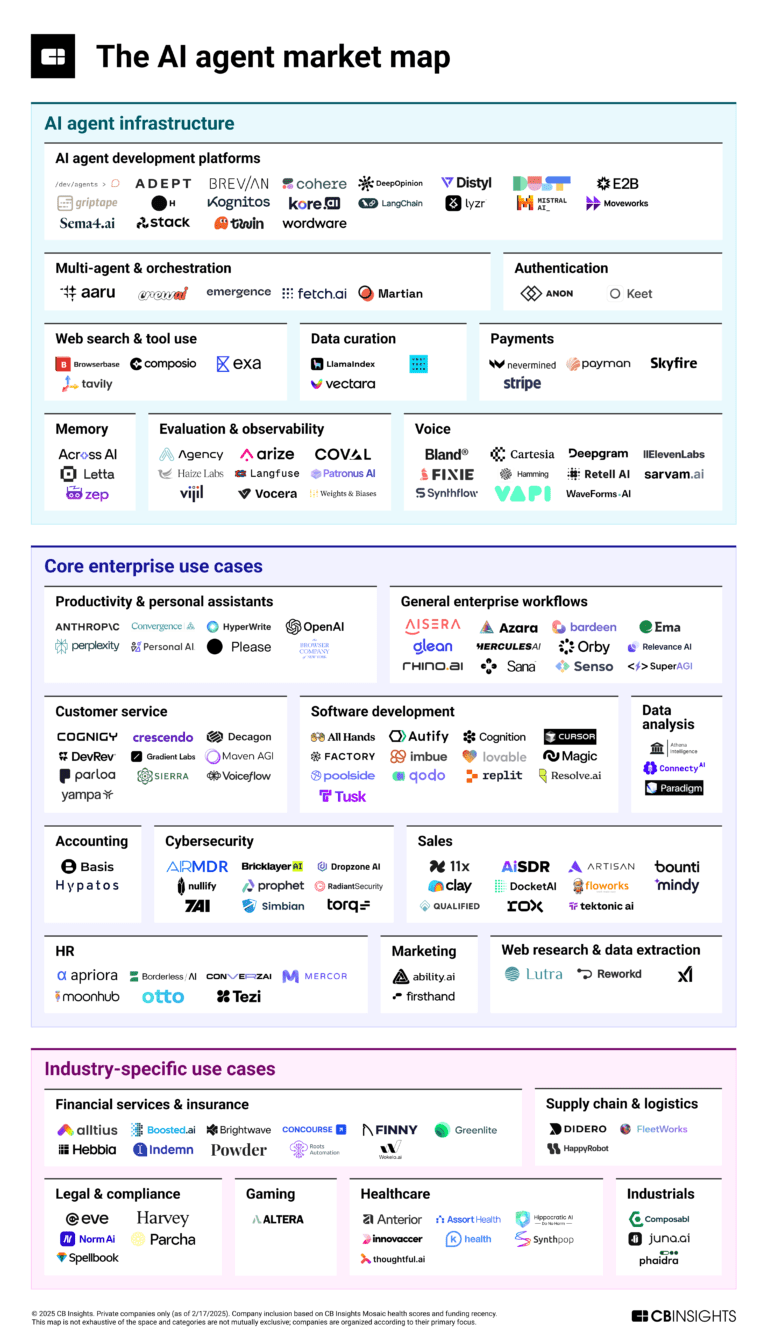
Mar 6, 2025
The AI agent market map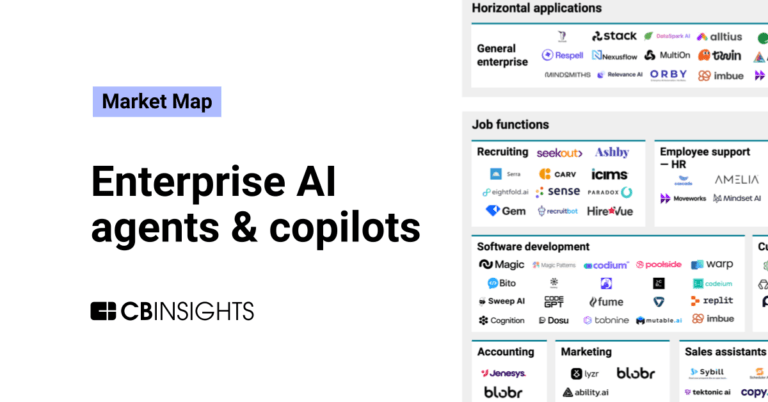
Aug 7, 2024
The enterprise AI agents & copilots market mapExpert Collections containing Simbian
Expert Collections are analyst-curated lists that highlight the companies you need to know in the most important technology spaces.
Simbian is included in 5 Expert Collections, including Cybersecurity.
Cybersecurity
11,028 items
These companies protect organizations from digital threats.
AI Agents & Copilots Market Map (August 2024)
322 items
Corresponds to the Enterprise AI Agents & Copilots Market Map: https://app.cbinsights.com/research/enterprise-ai-agents-copilots-market-map/
AI agents
376 items
Companies developing AI agent applications and agent-specific infrastructure. Includes pure-play emerging agent startups as well as companies building agent offerings with varying levels of autonomy. Not exhaustive.
Artificial Intelligence (AI)
37,222 items
Companies developing artificial intelligence solutions, including cross-industry applications, industry-specific products, and AI infrastructure solutions.
Generative AI
2,951 items
Companies working on generative AI applications and infrastructure.
Latest Simbian News
Oct 6, 2025
Opinion AI isn’t replacing your SOC team — it’s supercharging them, turning endless alerts into smart, proactive defenses against real threats. Credit: FOUNDRY. Every minute, your security operations center (SOC) is losing a race against time and drowning in a relentless, unwinnable game of whack-a-mole. The attacks are faster, more sophisticated and relentlessly automated. The alerts are a flood, overwhelming even the most seasoned analysts and leaving your organization vulnerable to the one threat that matters most: the one you don’t see coming. While traditional automation has provided a necessary relief, it remains insufficient to meet the volume and complexity of today’s threats. What if there was a way to turn the tide? To transform your defense from reactive to proactive? That is the promise of the AI-native SOC. This isn’t about replacing your expert analysts; it’s about equipping them with a force multiplier — advanced AI capabilities that create a more proactive and effective cybersecurity defense. GenAI: The analyst’s assistant on steroids Generative AI (genAI) is quickly becoming the first line of defense, transforming the lives of security analysts by automating the tedious, repetitive tasks that cause burnout. Automating mundane tasks: GenAI can ingest vast amounts of log data and threat intelligence feeds to instantly summarize alerts, draft comprehensive incident reports and create detailed threat actor profiles. This crucial capability eliminates the “swivel-chair” fatigue that plagues security analysts who constantly switch between disparate tools. Intelligent triage: By synthesizing data from multiple sources, including your SIEM, EDR and network logs, genAI provides the human analyst with a concise, actionable summary of an alert. This drastically reduces false positives, allowing analysts to accelerate decision-making on genuine threats. Knowledge democratization: Imagine your junior analysts operating with the speed and insight of a seasoned veteran. GenAI makes this possible. Using natural language prompts, any team member can query massive threat intelligence databases, effectively democratizing access to deep knowledge and elevating the entire team’s operational level. As explored by Palo Alto Networks , generative AI in cybersecurity is a powerful tool for both defenders and attackers, enhancing threat detection and automating security measures. Agentic AI: The spectrum of autonomy While genAI excels at suggestion and synthesis, agentic AI represents the true leap forward. The idea of a fully autonomous “human-on-the-loop” model is often too simplistic; the reality is a spectrum of autonomy where agents are given varying levels of freedom based on the task’s risk and complexity. Level 1: Recommendation engine. At the lowest level, the agent acts as a powerful suggestion box, providing a human with a clear course of action (e.g., “Recommend isolating this host”). The human analyst makes the final decision. Level 2: Automated actions. Here, the agent is pre-authorized to perform low-risk, well-defined tasks without human approval (e.g., “Automatically block a known malicious IP address”). This handles common, high-volume threats instantly. Level 3: Full autonomy. This is the “human-on-the-loop” ideal, reserved for critical scenarios. For example, an agent could autonomously detect a suspicious login, immediately investigate related user activity and isolate the host from the network without a human needing to click a button. This is applied when time is of the essence and a false negative could have catastrophic consequences. This spectrum of autonomy is the foundation for a more intelligent and efficient defense. At its peak, this tiered system powers a multi-agent system where specialized agents — one for threat detection, another for malware analysis and a third for containment — work together seamlessly to resolve complex incidents. According to Torq , multi-agent systems represent a new era for SecOps by enabling teams to scale, automate and respond to threats significantly faster. The human analyst supervises this entire orchestration, stepping in only for validation or unforeseen circumstances. Finally, agentic AI makes proactive threat hunting a reality. Instead of waiting for alarms, an agent can continuously scan your network for subtle indicators of compromise (IOCs) and anomalous behavior, proactively finding and neutralizing threats that might otherwise go unnoticed. As explained by Simbian AI , agentic AI systems can autonomously and dynamically plan, reason and act in real-time to solve complex issues, making them ideal for threat hunting. This moves your defense from a reactive posture, where you simply respond to alerts, to a proactive one, where you actively hunt for threats. The strategic mandate: Moving to cyber resilience The future of cybersecurity is not a zero-sum game of human versus AI; it is a symbiotic relationship. The integration of generative and agentic AI fundamentally redefines the security function, shifting the focus of human analysts from data processing and alert triage to strategic analysis and validation of AI actions. The imperative of responsible AI As we embrace these powerful technologies, the conversation must also turn to responsibility. GenAI and agentic AI are tools that can be as effective for our adversaries as they are for us. Without a foundation of ethical principles, robust guardrails, governance and “compliance by design”, we risk introducing new vulnerabilities, bias and unintended consequences into our defense systems. It is our duty to ensure these systems are transparent, auditable and operate with integrity. Agentic systems must be built with the highest security standards, including strict access controls, continuous behavioral monitoring and isolating AI workloads to contain potential breaches. Navigating this new era requires more than just technical expertise; it demands a commitment to ethical deployment. In my upcoming blogs this month, I will dive deeper into the attack surfaces, the ethical frameworks and practical strategies required to build and govern a truly responsible AI-native SOC. For CIOs, CISOs and SOC leaders, the mandate is clear: Invest strategically: Prioritize investment not just in the technology, but in the integration and workflow redesign necessary to support this new spectrum of autonomous operations. Augment your talent: Focus on training your teams to understand, manage and validate this new, augmented security force, ensuring they are prepared to operate in the AI-Native SOC. By embracing the AI-native SOC, your organization moves beyond mere reactive defense toward true proactive cyber resilience. The next era of cybersecurity belongs to those who successfully combine human intelligence with artificial autonomy. This article is published as part of the Foundry Expert Contributor Network.
Simbian Frequently Asked Questions (FAQ)
When was Simbian founded?
Simbian was founded in 2023.
Where is Simbian's headquarters?
Simbian's headquarters is located at 809 Cuesta Drive, Mountain View.
What is Simbian's latest funding round?
Simbian's latest funding round is Seed VC - II.
How much did Simbian raise?
Simbian raised a total of $10.5M.
Who are the investors of Simbian?
Investors of Simbian include Wipro Ventures, Olivier Pomel, Pankaj Patel, Rain Capital, secure octane and 13 more.
Who are Simbian's competitors?
Competitors of Simbian include Bricklayer AI and 5 more.
Loading...
Compare Simbian to Competitors

Prophet focuses on automating security operations through its platform. It provides solutions that triage, investigate, and respond to security alerts, which may reduce investigation time and improve operational efficiency. It serves sectors that require cybersecurity measures, such as technology, finance, and healthcare. It was founded in 2024 and is based in Atherton, California.

Bricklayer AI provides cybersecurity solutions within the technology sector, using multi-agent LLM-based AI to support security teams. The company offers an automated AI Security Analyst, Threat Intelligence Analyst, and Incident Responder that manage complex security incidents with minimal human intervention, continuously learning and collaborating to improve defenses. Bricklayer AI's solutions primarily serve sectors that require strong cybersecurity measures. It was founded in 2023 and is based in Arlington, Virginia.

Torq specializes in security hyper-automation within the cybersecurity industry. It offers a no-code platform that unifies and automates security workflows and infrastructure, helping in productivity and protection for enterprise security teams. Torq was formerly known as StackPulse. The company was founded in 2020 and is based in Tel Aviv, Israel.

Intezer focuses on the development of its Autonomous SOC Platform designed to support security operations. The company offers solutions for the triage, investigation, and remediation of security alerts, with the aim of automating incident response processes. Intezer's technology is primarily utilized by security operations centers (SOCs) to assist analysts by resolving false positives and escalating serious threats. It was founded in 2015 and is based in New York, New York.

Conifers.ai provides AI SOC agents platform within the cybersecurity industry. The company offers a cognitiveSOC solution that employs adaptive learning and deep contextual investigations to support security operations centers (SOCs). Conifers.ai serves the cybersecurity sector, focusing on Managed Security Service Providers (MSSPs) and Managed Detection and Response (MDR) services. It was founded in 2024 and is based in Dallas, Texas.

Qevlar AI focuses on autonomous security operations in the cybersecurity industry. The company provides solutions that address cyber threats, including alert investigation, threat analysis, and incident response automation. Qevlar AI serves Managed Security Service Providers (MSSPs) and enterprise security operations centers. It was founded in 2023 and is based in New York, New York.
Loading...