

WRITER
Founded Year
2015Stage
Series C | AliveTotal Raised
$344.68MValuation
$0000Last Raised
$200M | 1 yr agoRevenue
$0000Mosaic Score The Mosaic Score is an algorithm that measures the overall financial health and market potential of private companies.
+1 points in the past 30 days
About WRITER
Writer operates as a full-stack generative artificial intelligence (AI) platform focused on the development of AI applications and agents for various business sectors. The company provides tools for building, activating, and supervising AI agents, using its family of large language models (LLMs) and knowledge graph technology. Writer's solutions serve enterprises in industries such as financial services, healthcare, retail, and technology, aiming to improve operational efficiency and decision-making processes. WRITER was formerly known as Qordoba. It was founded in 2015 and is based in San Francisco, California.
Loading...
WRITER's Product Videos


ESPs containing WRITER
The ESP matrix leverages data and analyst insight to identify and rank leading companies in a given technology landscape.
The AI agent builder platforms market offers no-code and low-code solutions for business users to create and deploy AI agents without programming expertise. These platforms provide drag-and-drop interfaces, pre-built templates, and visual workflow builders for automating tasks like customer support, scheduling, and lead qualification. Key features include integrations with business tools, multi-ch…
WRITER named as Leader among 15 other companies, including Zapier, Salesforce, and Glean.
WRITER's Products & Differentiators
Palmyra LLMs
WRITER's state-of-the-art enterprise LLMs to power agent reasoning, actions, memory, and learning. These include both large general-purpose reasoning models as well as fine-tuned models for domains such as finance & healthcare. WRITER's models are secure, transparently built, multimodal, and top-ranked on industry benchmarks. Customers can audit, test, and fine-tune our models.
Loading...
Research containing WRITER
Get data-driven expert analysis from the CB Insights Intelligence Unit.
CB Insights Intelligence Analysts have mentioned WRITER in 17 CB Insights research briefs, most recently on Oct 3, 2025.
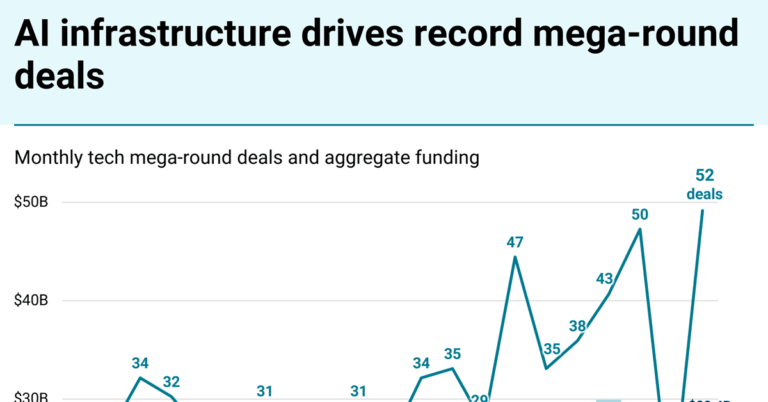
Oct 3, 2025 report
Dual AI engines: LLMs and optimizers sweep September mega-round funding
Aug 29, 2025 report
Book of Scouting Reports: Generative AI in Financial Services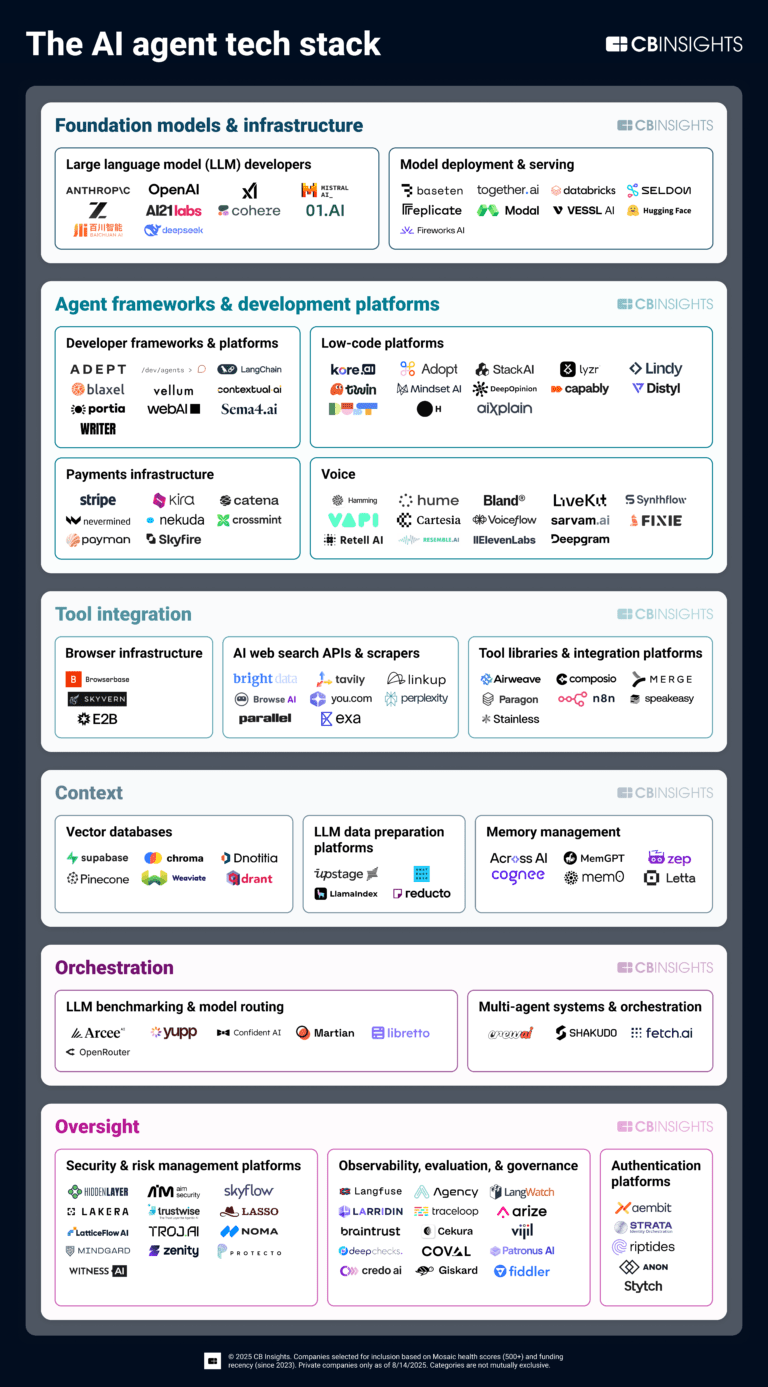
Aug 22, 2025
The AI agent tech stack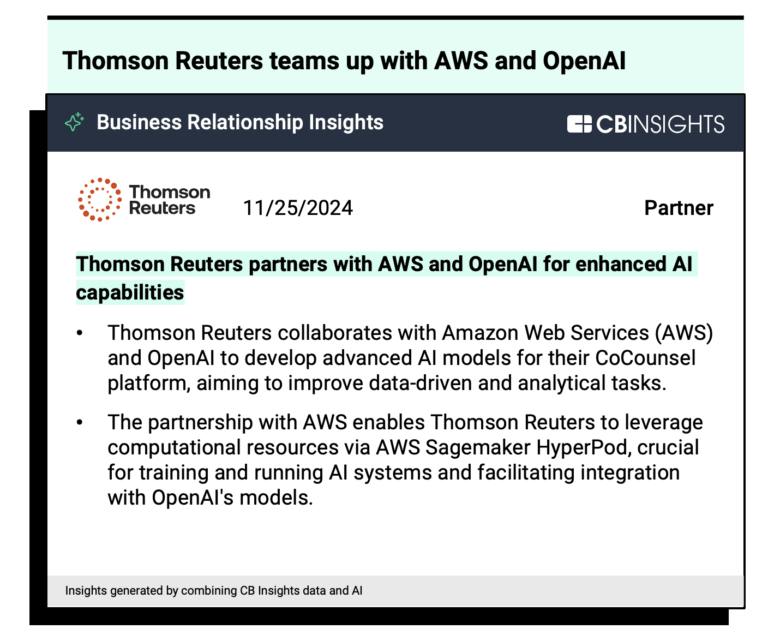
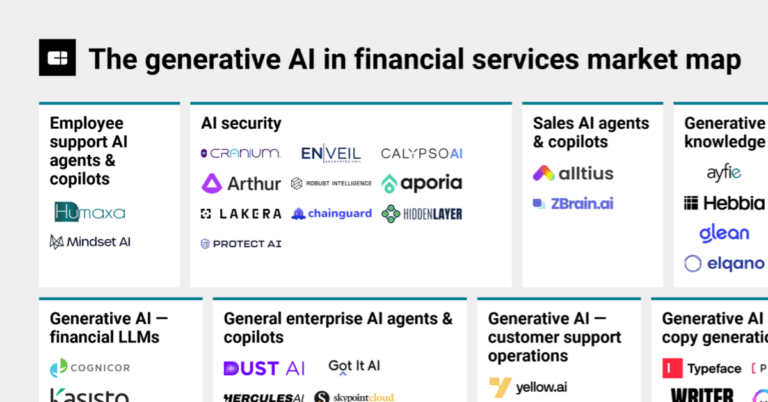
Oct 17, 2024
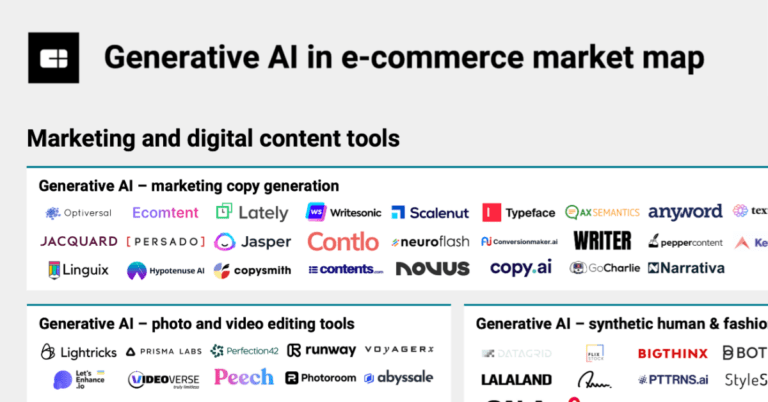
The generative AI for e-commerce market map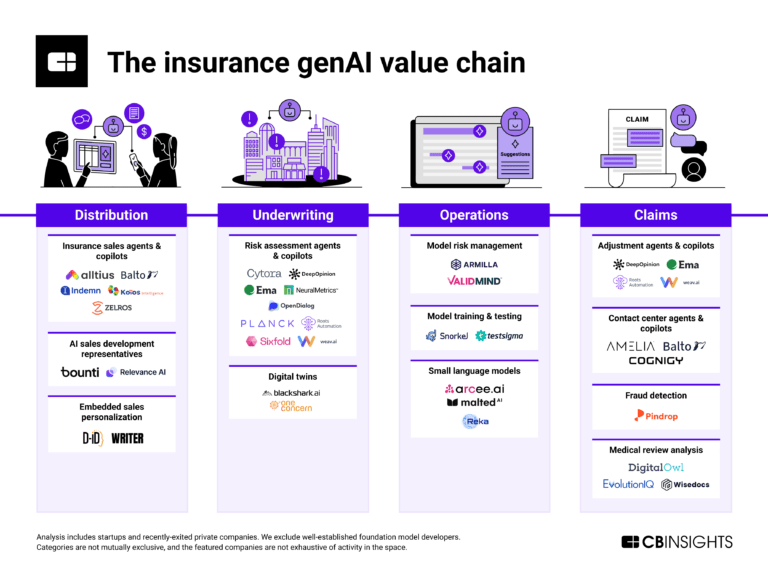
Oct 11, 2024
How genAI is reshaping the insurance value chain
Expert Collections containing WRITER
Expert Collections are analyst-curated lists that highlight the companies you need to know in the most important technology spaces.
WRITER is included in 9 Expert Collections, including Unicorns- Billion Dollar Startups.
Unicorns- Billion Dollar Startups
1,297 items
Artificial Intelligence (AI)
37,233 items
Companies developing artificial intelligence solutions, including cross-industry applications, industry-specific products, and AI infrastructure solutions.
Digital Content & Synthetic Media
2,388 items
The Synthetic Media collection includes companies that use artificial intelligence to generate, edit, or enable digital content under all forms, including images, videos, audio, and text, among others.
Retail Media Networks
143 items
Generative AI
2,951 items
Companies working on generative AI applications and infrastructure.
AI 100 (2024)
100 items
WRITER Patents
WRITER has filed 3 patents.

Application Date | Grant Date | Title | Related Topics | Status |
|---|---|---|---|---|
8/29/2019 | 7/19/2022 | Natural language processing, Computational linguistics, Machine learning, Artificial intelligence, Tasks of natural language processing | Grant |
Application Date | 8/29/2019 |
|---|---|
Grant Date | 7/19/2022 |
Title | |
Related Topics | Natural language processing, Computational linguistics, Machine learning, Artificial intelligence, Tasks of natural language processing |
Status | Grant |
Latest WRITER News
Oct 23, 2025
Tuesday, revealing that nearly half of Fortune 500 executives believe artificial intelligence is actively damaging their organizations — and placing the blame squarely on leadership's shoulders. The problem, according to Habib, isn't the technology. It's that business leaders are making a category error, treating AI transformation like previous technology rollouts and delegating it to IT departments. This approach, she warned, has led to "billions of dollars spent on AI initiatives that are going nowhere." "Earlier this year, we did a survey of 800 Fortune 500 C-suite executives," Habib told the audience of Silicon Valley executives and investors. "42% of them said AI is tearing their company apart." The diagnosis challenges conventional wisdom about how enterprises should approach AI adoption. While most major companies have stood up AI task forces appointed chief AI officers , or expanded IT budgets , Habib argues these moves reflect a fundamental misunderstanding of what AI represents: not another software tool, but a wholesale reorganization of how work gets done. "There is something leaders are missing when they compare AI to just another tech tool," Habib said. "This is not like giving accountants calculators or bankers Excel or designers Photoshop." Why the 'old playbook' of delegating to IT departments is failing companies Habib, whose company has spent five years building AI systems for Fortune 500 companies and logged two million miles visiting customer sites, said the pattern is consistent: "When generative AI started showing up, we turned to the old playbook. We turned to IT and said, 'Go figure this out.'" That approach fails, she argued, because AI fundamentally changes the economics and organization of work itself. "For 100 years, enterprises have been built around the idea that execution is expensive and hard," Habib said. "The enterprise built complex org charts, complex processes, all to manage people doing stuff." AI inverts that model. "Execution is going from scarce and expensive to programmatic, on-demand and abundant," she said. In this new paradigm, the bottleneck shifts from execution capacity to strategic design — a shift that requires business leaders, not IT departments, to drive transformation. "With AI technology, it can no longer be centralized. It's in every workflow, every business," Habib said. "It is now the most important part of a business leader's job. It cannot be delegated." The statement represents a direct challenge to how most large organizations have structured their AI initiatives, with centralized centers of excellence, dedicated AI teams, or IT-led implementations that business units are expected to adopt. A generational power shift is happening based on who understands AI workflow design Habib framed the shift in dramatic terms: "A generational transfer of power is happening right now. It's not about your age or how long you've been at a company. The generational transfer of power is about the nature of leadership itself." Traditional leadership, she argued, has been defined by the ability to manage complexity — big teams, big budgets, intricate processes. "The identity of leaders at these companies, people like us, has been tied to old school power structures: control, hierarchy, how big our teams are, how big our budgets are. Our value is measured by the sheer amount of complexity we could manage," Habib said. "Today we reward leaders for this. We promote leaders for this." AI makes that model obsolete. "When I am able to 10x the output of my team or do things that could never be possible, work is no longer about the 1x," she said. "Leadership is no longer about managing complex human execution." Instead, Habib outlined three fundamental shifts that define what she calls "AI-first leaders" — executives her company has worked with who have successfully deployed AI agents solving "$100 million plus problems." The first shift: Taking a machete to enterprise complexity The new leadership mandate, according to Habib, is "taking a machete to the complexity that has calcified so many organizations." She pointed to the layers of friction that have accumulated in enterprises: "Brilliant ideas dying in memos, the endless cycles of approvals, the death by 1,000 clicks, meetings about meetings — a death, by the way, that's happening in 17 different browser tabs each for software that promises to be a single source of truth." Rather than accepting this complexity as inevitable, AI-first leaders redesign workflows from first principles. "There are very few legacy systems that can't be replaced in your organization, that won't be replaced," Habib said. "But they're not going to be replaced by another monolithic piece of software. They can only be replaced by a business leader articulating business logic and getting that into an agentic system." She offered a concrete example: "We have customers where it used to take them seven months to get a creative campaign — not even a product, a campaign. Now they can go from TikTok trend to digital shelf in 30 days. That is radical simplicity." The catch, she emphasized, is that CIOs can't drive this transformation alone. "Your CIO can't help flatten your org chart. Only a business leader can look at workflows and say, 'This part is necessary genius, this part is bureaucratic scar tissue that has to go.'" The second shift: Managing the fear as career ladders disappear When AI handles execution, "your humans are liberated to do what they're amazing at: judgment, strategy, creativity," Habib explained. "The old leadership playbook was about managing headcount. We managed people against revenue: one business development rep for every three account executives, one marketer for every five salespeople." But this liberation carries profound challenges that leaders must address directly. Habib acknowledged the elephant in the room that many executives avoid discussing: "These changes are still frightening for people, even when it's become unholy to talk about it." She's witnessed the fear firsthand. "It shows up as tears in an AI workshop when someone feels like their old skill set isn't translated to the new." She introduced a term for a common form of resistance: "productivity anchoring" — when employees "cling to the hard way of doing things because they feel productive, because their self-worth is tied to them, even when empirically AI can be better." The solution isn't to look away. "We have to design new pathways to impact, to show your people their value is not in executing a task. Their value is in orchestrating systems of execution, to ask the next great question," Habib said. She advocates replacing career "ladders" with "lattices" where "people need to grow laterally, to expand sideways." She was candid about the disruption: "The first rungs on our career ladders are indeed going away. I know because my company is automating them." But she insisted this creates opportunity for work that is "more creative, more strategic, more driven by curiosity and impact — and I believe a lot more human than the jobs that they're replacing." The third shift: When execution becomes free, ambition becomes the only bottleneck The final shift is from optimization to creation. "Before AI, we used to call it transformation when we took 12 steps and made them nine," Habib said. "That's optimizing the world as it is. We can now create a new world. That is the greenfield mindset." She challenged executives to identify assumptions their industries are built on that AI now disrupts. Writer's customers, she said, are already seeing new categories of growth: treating every customer like their only customer, democratizing premium services to broader markets, and entering new markets at unprecedented speed because "AI strips away the friction to access new channels." "When execution is abundant, the only bottleneck is the scope of your own ambition," Habib declared. What this means for CIOs: Building the stadium while business leaders design the plays Habib didn't leave IT leaders without a role — she redefined it. "If tech is everyone's job, you might be asking, what is mine?" she addressed CIOs. "Yours is to provide the mission critical infrastructure that makes this revolution possible." As tens or hundreds of thousands of AI agents operate at various levels of autonomy within organizations, "governance becomes existential," she explained. "The business leader's job is to design the play, but you have to build the stadium, you have to write the rule book, and you have to make sure these plays can win at championship scale." The formulation suggests a partnership model: business leaders drive workflow redesign and strategic implementation while IT provides the infrastructure, governance frameworks, and security guardrails that make mass AI deployment safe and scalable. "One can't succeed without the other," Habib said. For CIOs and technical leaders, this represents a fundamental shift from gatekeeper to enabler. When business units deploy agents autonomously, IT faces governance challenges unlike anything in enterprise software history. Success requires genuine partnership between business and IT — neither can succeed alone, forcing cultural changes in how these functions collaborate. A real example: From multi-day scrambles to instant answers during a market crisis To ground her arguments in concrete business impact, Habib described working with the chief client officer of a Fortune 500 wealth advisory firm during recent market volatility following tariff announcements. "Their phone was ringing off the hook with customers trying to figure out their market exposure," she recounted. "Every request kicked off a multi-day, multi-person scramble: a portfolio manager ran the show, an analyst pulled charts, a relationship manager built the PowerPoint, a compliance officer had to review everything for disclosures. And the leader in all this — she was forwarding emails and chasing updates. This is the top job: managing complexity." With an agentic AI system, the same work happens programmatically. "A system of agents is able to assemble the answer faster than any number of people could have. No more midnight deck reviews. No more days on end" of coordination, Habib said. This isn't about marginal productivity gains — it's about fundamentally different operating models where senior executives shift from managing coordination to designing intelligent systems. Why so many AI initiatives are failing despite massive investment Habib's arguments arrive as many enterprises face AI disillusionment. After initial excitement about generative AI, many companies have struggled to move beyond pilots and demonstrations to production deployments generating tangible business value. Her diagnosis — that leaders are delegating rather than driving transformation — aligns with growing evidence that organizational factors, not technical limitations, explain most failures. Companies often lack clarity on use cases, struggle with data preparation, or face internal resistance to workflow changes that AI requires. Perhaps the most striking aspect of Habib's presentation was her willingness to acknowledge the human cost of AI transformation — and insist leaders address it rather than avoid it. "Your job as a leader is to not look away from this fear. Your job is to face it with a plan," she told the audience. She described "productivity anchoring" as a form of "self-sabotage" where employees resist AI adoption because their identity and self-worth are tied to execution tasks AI can now perform. The phenomenon suggests that successful AI transformation requires not just technical and strategic changes but psychological and cultural work that many leaders may be unprepared for. Two challenges: Get your hands dirty, then reimagine everything Habib closed by throwing down two gauntlets to her executive audience. "First, a small one: get your hands dirty with agentic AI. Don't delegate. Choose a process that you oversee and automate it. See the difference from managing a complex process to redesigning it for yourself." The second was more ambitious: "Go back to your team and ask, what could we achieve if execution were free? What would work feel like, be like, look like if you're unbound from the friction and process that slows us down today?" She concluded: "The tools for creation are in your hands. The mandate for leadership is on your shoulders. What will you build?" For enterprise leaders accustomed to viewing AI as an IT initiative, Habib's message is clear: that approach isn't working, won't work, and reflects a fundamental misunderstanding of what AI represents. Whether executives embrace her call to personally drive transformation — or continue delegating to IT departments — may determine which organizations thrive and which become cautionary tales. The statistic she opened with lingers uncomfortably: 42% of Fortune 500 C-suite executives say AI is tearing their companies apart. Habib's diagnosis suggests they're tearing themselves apart by clinging to organizational models designed for an era when execution was scarce. The cure she prescribes requires leaders to do something most find uncomfortable: stop managing complexity and start dismantling it.
WRITER Frequently Asked Questions (FAQ)
When was WRITER founded?
WRITER was founded in 2015.
Where is WRITER's headquarters?
WRITER's headquarters is located at 111 Maiden Lane, San Francisco.
What is WRITER's latest funding round?
WRITER's latest funding round is Series C.
How much did WRITER raise?
WRITER raised a total of $344.68M.
Who are the investors of WRITER?
Investors of WRITER include Upfront Ventures, Aspect Ventures, Broadway Angels, Insight Partners, Gradient Ventures and 62 more.
Who are WRITER's competitors?
Competitors of WRITER include Addlly AI, Cohere, Anthropic, Upstage, Superhuman and 7 more.
What products does WRITER offer?
WRITER's products include Palmyra LLMs and 4 more.
Who are WRITER's customers?
Customers of WRITER include Vanguard, Uber, CirrusMD and Franklin Templeton Investments.
Loading...
Compare WRITER to Competitors

Jasper operates as an artificial intelligence (AI) content creation platform. The company's main services include the creation of on-brand AI-assisted content, language translation, and the generation of marketing campaigns. It is primarily used in the marketing and advertising industry. Jasper was formerly known as Proof Technologies. It was founded in 2020 and is based in Austin, Texas.

Contents specializes in artificial intelligence (AI) content creation for enterprises across various sectors. The company offers a generative AI-driven platform that streamlines content creation processes and delivers personalized content at scale. Contents primarily serves sectors such as electronic commerce (e-commerce), publishing, digital marketing, and large multinational corporations. It was founded in 2021 and is based in Milano, Italy. Contents operates as a subsidiary of Entire Digital.

Writesonic is a generative AI platform that focuses on content creation, SEO optimization, and AI chatbot development. The company offers tools for crafting factually accurate content with real-time data, optimizing content for search engines, and building custom AI chatbots trained on user data. Writesonic primarily serves marketers, agencies, and enterprises looking to enhance their digital content and customer engagement strategies. It was founded in 2021 and is based in San Francisco, California.

Copyrytr is a company focused on AI copywriting solutions within the content creation tools industry. They offer a suite of content and copywriting platforms that utilize artificial intelligence to enhance digital content creation and improve conversion rates. The company primarily serves sectors such as freelancers, enterprise teams, eCommerce businesses, startup founders, SEO teams, and agencies. It was founded in 2022 and is based in Birmingham, Alabama.

Mutiny specializes in AI-powered website personalization and account-based marketing for the B2B sector. Its main offerings include creating personalized experiences and microsites for target accounts, as well as providing account intelligence without the need for coding. Mutiny's solutions are designed to help businesses increase their pipeline and revenue by tailoring their website content to individual visitors and accounts. It was founded in 2018 and is based in San Francisco, California.

Copysmith provides AI writing tools for various content needs. Its offerings include products that assist in generating product descriptions, SEO articles, and content for emails, blogs, and ads. Its tools aim to support eCommerce teams and content writers by providing AI suggestions and optimizations. It was founded in 2020 and is based in San Francisco, California.
Loading...