

Modal
Founded Year
2021Stage
Series B | AliveTotal Raised
$110MValuation
$0000Last Raised
$87M | 1 mo agoMosaic Score The Mosaic Score is an algorithm that measures the overall financial health and market potential of private companies.
+79 points in the past 30 days
About Modal
Modal specializes in AI infrastructure within the technology sector. The company offers a platform that enables developers to run inference, training, and batch processing with cold starts, autoscaling, and a developer experience. Modal's services support machine learning teams looking to deploy models and scale workloads across multiple CPUs and GPUs. It was founded in 2021 and is based in New York, New York.
Loading...
ESPs containing Modal
The ESP matrix leverages data and analyst insight to identify and rank leading companies in a given technology landscape.
The cloud graphics processing unit (GPU) market delivers GPU capabilities through cloud-based platforms, enabling users to leverage high-performance computing without on-premises infrastructure. These services support graphics-intensive and parallel processing workloads such as AI training, 3D modeling, scientific simulations, and video rendering. Companies in this market provide flexible scalabil…
Modal named as Challenger among 15 other companies, including Microsoft, Oracle, and IBM.
Loading...
Research containing Modal
Get data-driven expert analysis from the CB Insights Intelligence Unit.
CB Insights Intelligence Analysts have mentioned Modal in 2 CB Insights research briefs, most recently on Oct 24, 2025.
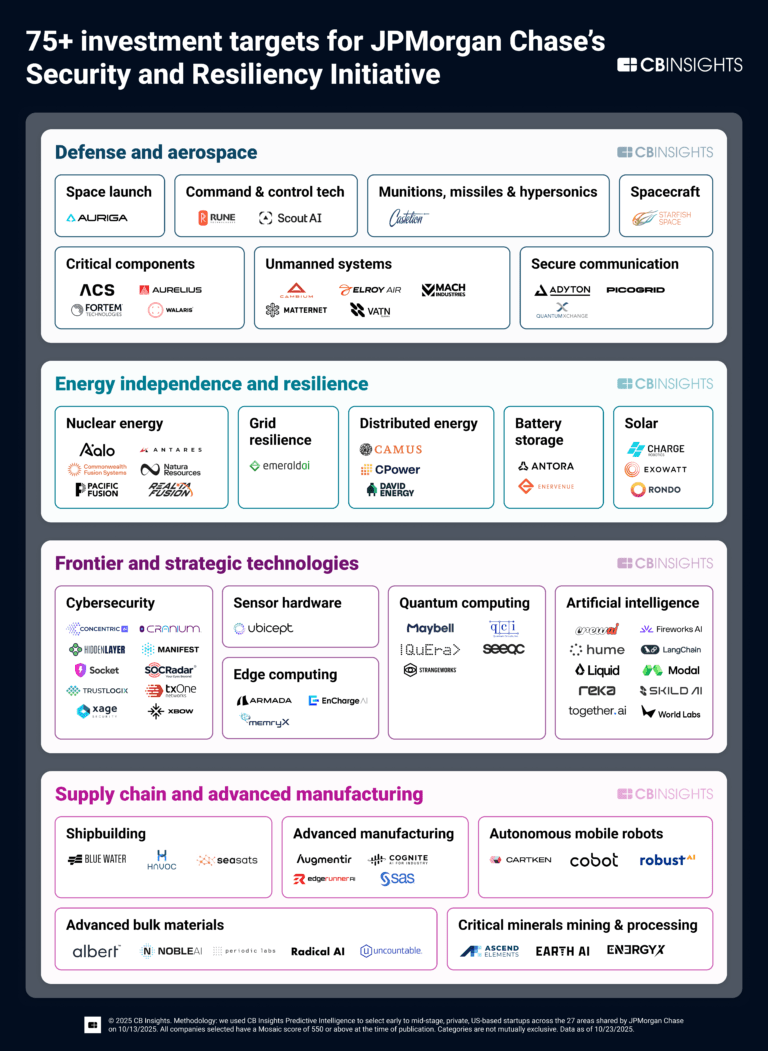
Sep 5, 2025 report
Book of Scouting Reports: The AI Agent Tech StackExpert Collections containing Modal
Expert Collections are analyst-curated lists that highlight the companies you need to know in the most important technology spaces.
Modal is included in 1 Expert Collection, including Artificial Intelligence (AI).
Artificial Intelligence (AI)
20,629 items
Latest Modal News
Oct 22, 2025
Global Plastics Outlook . The Align Foundation has launched the 2025 Protein Engineering Tournament, a global open-science challenge that uses AI and lab testing to improve enzymes capable of breaking down plastic waste. It is one of the first competitions to pair AI-driven enzyme design with large-scale experimental validation. “Creating a benchmark that scientists can rally around is a powerful way to advance a field” — Erika DeBenedictis, PhD, co-founder of The Align Foundation. The response has been global: more than 290 teams from 40 countries have already registered to tackle PETase, the plastic-degrading enzyme at the heart of the challenge. The tournament is backed by sponsors including Twist Bioscience, Modal Labs, and EvolutionaryScale. Why PETase PETase can break down PET into reusable monomers that can be made into new, high-quality plastic. Unlike traditional recycling, which often downgrades plastic into lower-value products, enzymatic recycling offers true circularity: reducing landfill waste, cutting demand for petroleum, and enabling sustainable manufacturing. For over a decade, researchers have struggled to engineer PETase that can withstand the harsh conditions of recycling plants. The enzyme must remain active at high temperatures, tolerate swings in pH, and act on solid plastic. These hurdles have stalled progress, even as plastic pollution costs the world more than $1.5 trillion annually in health-related economic losses (The Lancet Commission on Plastics, 2023) and between $500 billion and $2.5 trillion per year in lost marine ecosystem services (UNEP estimate reported by NCEL, 2019). The Protein Engineering Tournament addresses this challenge by crowdsourcing innovation and validating new enzyme variants under real-world conditions. How the Tournament Works High-visibility challenges have sparked breakthroughs before: DARPA's Grand Challenge seeded today's autonomous vehicle industry, and CASP transformed protein structure prediction. Benchmarks give a field a common test, allowing competing approaches to be compared under the same conditions. Align's Protein Engineering Tournament aims to do the same for protein function. “Creating a benchmark that scientists can rally around is a powerful way to advance a field,” said Erika DeBenedictis, PhD, co-founder of The Align Foundation. “This tournament sets that benchmark for functional protein engineering by testing whether models can deliver enzymes that aren't just structurally correct, but actually work in the real world.” The tournament begins December 1st and will unfold in two phases: Twist Bioscience, the competition's DNA synthesis sponsor, will provide variant libraries and gene fragments to build a first-of-its-kind functional dataset for PETase. They will also synthesize DNA encoding novel PETase sequences designed by the competing teams. By supplying the synthetic DNA that bridges digital designs with biological results, Twist ensures that every team's ideas can be tested fairly and potentially be turned into tangible breakthroughs. “Synthetic DNA plays a critical role in AI-based discovery, from providing researchers with sequences and datasets to train their models, and the validation of those models in the wet lab,” said Emily M. Leproust, Ph.D., CEO and co-founder of Twist Bioscience. “With both library and gene synthesis, we support end-to-end development of novel algorithms to discover new PETase enzymes for plastic degradation, ensuring each team's designs can be validated and tested fairly in the lab.” EvolutionaryScale, the AI sponsor, will give participants access to state-of-the-art protein language models developed by them. Modal Labs will provide participants with compute on their platform, enabling them to quickly parallelize intensive computational testing of their models. These sponsorships, along with robust experimental testing enabled by Align, will ensure that teams compete on ideas rather than availability of infrastructure. Who's Participating The tournament is organized by The Align Foundation, with technical leadership from Bijoy Desai, PhD, Align's tournament program manager, and an interdisciplinary planning committee spanning academia, biotech, and AI. Registered participants range from leading academic groups, including the Frances Arnold Lab at Caltech and the Baker Lab at the University of Washington, to AI-driven companies like Profluent, alongside hundreds of other teams worldwide. Participation is free, and all experimental work is handled by Align so teams can focus on modeling and design. Building on Prior Success Align piloted this approach in 2023 with an amylase engineering competition that drew 30 teams and published results in Proteins The 2025 tournament expands that model in scale and ambition. Success could accelerate sustainable plastic recycling and establish a reusable framework for enzyme design, while even failure will map the limits of today's methods and guide the next wave of progress. Learn more and register: https://alignbio.org/protein-engineering-tournament-2025 About The Align Foundation The Align Foundation is a research nonprofit launched in 2021 to make life sciences more predictive. Align enables the building of large, open biological datasets through high-throughput experimentation, automation partnerships, and global scientific collaboration. Align also hosts competitions to transparently benchmark scientific progress and measure the impact of open data. With support from philanthropic funders, Align is creating the reproducible, scalable, and shareable infrastructure needed to unlock the next generation of data-powered breakthroughs in biology. Learn more at alignbio.org.
Modal Frequently Asked Questions (FAQ)
When was Modal founded?
Modal was founded in 2021.
Where is Modal's headquarters?
Modal's headquarters is located at 584 Broadway, New York.
What is Modal's latest funding round?
Modal's latest funding round is Series B.
How much did Modal raise?
Modal raised a total of $110M.
Who are the investors of Modal?
Investors of Modal include Redpoint Ventures, Lux Capital, Amplify Partners, Firestreak, Definition Capital and 3 more.
Who are Modal's competitors?
Competitors of Modal include Runhouse, DataCrunch, Baseten, Cerebrium, Riza and 7 more.
Loading...
Compare Modal to Competitors
Coiled provides a cloud platform for data processing and parallel computing within the Python programming environment. The company offers tools and infrastructure for users to run Python code on cloud resources, using the Dask library for distributed computing and data analysis. Coiled's services are aimed at data scientists and engineers who want to scale their Python applications with cloud resources. It was founded in 2020 and is based in New York, New York.
Prime Intellect develops a platform for discovering compute resources and supports distributed training of AI models. The company focuses on collective ownership of open AI innovations, including language models and scientific models, and engages in research related to decentralized training methods. It was founded in 2023 and is based in Dover, Delaware.
OuterBounds Technologies provides infrastructure for machine learning, artificial intelligence, and data science within the tech industry. The company offers tools for developing, scaling, and deploying ML and AI systems, including cloud workstations, computing resources, and deployment solutions. OuterBounds serves sectors that require ML and AI capabilities, such as finance, life sciences, e-commerce, entertainment, industrial, logistics, and software. OuterBounds Technologies was formerly known as Axiom Solutions International. It was founded in 2021 and is based in San Francisco, California. OuterBounds Technologies operates as a subsidiary of Caatoosee.
Runhouse provides managed AI training infrastructure within the technology sector, focusing on artificial intelligence and machine learning. The company has a compute platform that allows researchers and engineers to execute and scale machine learning workloads using frameworks like PyTorch, Ray, TensorFlow, and others, requiring infrastructure management. Runhouse serves sectors that utilize AI/ML capabilities, including technology and research institutions. It was founded in 2022 and is based in New York, New York.
Xorbits provides Artificial Intelligence (AI) inference platforms within the technology sector. It offers products for resource allocation, model life-cycle management, and resource utilization strategies for AI models. It serves sectors that require inference services, including the technology industry and businesses using AI. It was founded in 2022 and is based in Hangzhou, China.
Lumino provides decentralized computing solutions within the artificial intelligence sector. The company offers a protocol for training and fine-tuning artificial intelligence (AI) models in a decentralized manner. It was founded in 2023 and is based in San Mateo, California.
Loading...