

Merck
Founded Year
1668Stage
IPO | IPODate of IPO
10/20/1995Market Cap
50.02BStock Price
115.05Revenue
$0000About Merck
Merck operates in the sectors of life science, healthcare, and electronics. The company offers products and services for scientific research, healthcare advancements, and electronic materials. Merck serves the life science, healthcare, and electronics industries. It was founded in 1668 and is based in Darmstadt, Germany.
Loading...
ESPs containing Merck
The ESP matrix leverages data and analyst insight to identify and rank leading companies in a given technology landscape.
The semiconductor raw materials market supplies essential materials including photoresists, specialty chemicals, high-purity gases, and specialty metals required for semiconductor fabrication. This market also includes critical components such as chemical mechanical polishing (CMP) slurries and dielectrics used in wafer processing and integrated circuit manufacturing. These materials are increasin…
Merck named as Leader among 15 other companies, including Honeywell, BASF, and Air Liquide.
Loading...
Research containing Merck
Get data-driven expert analysis from the CB Insights Intelligence Unit.
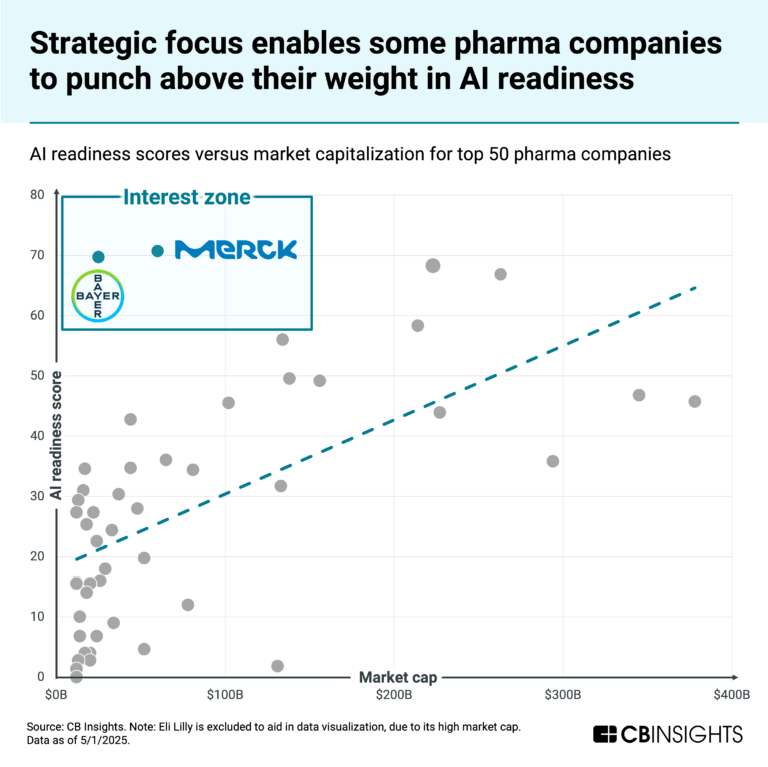
CB Insights Intelligence Analysts have mentioned Merck in 4 CB Insights research briefs, most recently on Aug 6, 2025.


Jul 2, 2024 team_blog
How to buy AI: Assessing AI startups’ potential
Expert Collections containing Merck
Expert Collections are analyst-curated lists that highlight the companies you need to know in the most important technology spaces.
Merck is included in 1 Expert Collection, including Conference Exhibitors.
Conference Exhibitors
5,302 items
Merck Patents
Merck has filed 612 patents.
The 3 most popular patent topics include:
- clusters of differentiation
- transcription factors
- monoclonal antibodies
Application Date | Grant Date | Title | Related Topics | Status |
|---|---|---|---|---|
11/26/2019 | 4/1/2025 | Clusters of differentiation, G protein coupled receptors, Immunology, Transcription factors, Adenosine receptor antagonists | Grant |
Application Date | 11/26/2019 |
|---|---|
Grant Date | 4/1/2025 |
Title | |
Related Topics | Clusters of differentiation, G protein coupled receptors, Immunology, Transcription factors, Adenosine receptor antagonists |
Status | Grant |
Latest Merck News
Oct 24, 2025
growth is driven by the increasing use of lipid nanoparticles (LNP) in drug delivery, RNA-based therapies, and vaccines. Key factors include advancements in nanotechnology, increased pharmaceutical and biotech investments, and growing adoption of RNA therapeutics. Despite challenges like high production costs and regulatory complexities, strategic partnerships and technological innovations are enhancing LNP applications, particularly in precision medicine, oncology, and infectious diseases. The market is witnessing significant regional growth, with California, Texas, New York, and Florida leading the way. Prominent companies in the sector include Merck KGaA KGaA, Evonik Industries, and Genevant Sciences. Dublin, Oct. 24, 2025 (GLOBE NEWSWIRE) -- The "United States Lipid Nanoparticle Market Report by Type, Application, End Use, States and Company Analysis, 2025-2033" report has been added to ResearchAndMarkets.com's offering. United States Lipid Nanoparticle Market is expected to reach US$ 519.18 billion by 2033 from US$ 210.34 billion in 2024, with a CAGR of 10.56% from 2025 to 2033 The market for lipid nanoparticles in the US is anticipated to grow gradually due to its use in drug delivery, RNA-based treatments, and vaccinations, which are aided by developments in pharmaceutical research and nanotechnology. The market for lipid nanoparticles in the US is expanding regionally, with biotechnology hubs seeing the most activity. With the help of strong research institutes, biotech clusters, and rising healthcare investments, California, Texas, New York, and Florida are at the forefront of development. The lipid nanoparticle market in the US is expanding rapidly as nanotechnology continues to transform therapeutic applications and drug delivery. Because lipid nanoparticles (LNPs) can improve bioavailability, stability, and targeted administration, they are being used more and more as carriers for proteins, small compounds, and nucleic acids. LNPs have become a key technology in RNA-based treatments, such as gene therapy, vaccinations, and personalized medicine, in recent years. Research investments and partnerships between biotechnology businesses, pharmaceutical corporations, and academic institutions are being fueled by the growing need for safe and efficient drug delivery platforms. This developing field emphasizes the increasing use of lipid nanoparticles to treat unmet medical needs in infectious diseases, genetic disorders, and oncology. Additionally, the need for LNP in the biotech and pharmaceutical sectors is being greatly impacted by the growing incidence of cancer worldwide. The American Cancer Society predicted that in 2024 alone, there will be 2,001,140 new cases of cancer in the United States and 611,720 deaths from the disease. The need for efficient and focused treatment alternatives is growing along with the incidence of cancer. Advances in formulation methods, regulatory clearances, and the growing commercialization of RNA-based products all contribute to the market's growth. With the help of government-sponsored healthcare programs and venture capital funding, the US has emerged as a major center for LNP research and development. Lipid nanoparticles are being used by pharmaceutical companies to improve therapeutic efficacy and minimize side effects, and contract research organizations (CROs) are meeting demand by offering specialized services. The U.S. market is positioned as a leader in this industry due to the expansion of LNP applications brought about by the emergence of precision medicine and the continuous development of customized treatments. High production costs, convoluted regulatory processes, and technological obstacles in large-scale manufacturing continue to be obstacles despite robust growth drivers. To get over these obstacles, businesses are spending more money on quality control systems and sophisticated production processes. The competitive landscape is also being shaped by strategic alliances and licensing contracts as businesses look to broaden their LNP portfolios and increase their worldwide presence. The U.S. lipid nanoparticle market is expected to continue its dynamic trajectory due to ongoing innovation and increased awareness of nanotechnology in healthcare, providing prospects for both well-established firms and up-and-coming biotech companies. Key Factors Driving the United States Lipid Nanoparticle Market Growth Growing Adoption in RNA-Based Therapeutics The increasing use of RNA-based therapeutics, including mRNA vaccines and gene therapies, is one of the most significant growth drivers of the U.S. lipid nanoparticle market. LNPs serve as highly efficient delivery vehicles for nucleic acids, protecting them from degradation and ensuring effective transport into target cells. Their proven success in vaccine delivery has highlighted their potential for broader applications in treating rare genetic disorders, cancer, and chronic diseases. Research pipelines across the country are increasingly incorporating lipid nanoparticle technologies to enhance drug efficacy and reduce side effects. This rising adoption is supported by both government funding initiatives and private sector investments, positioning lipid nanoparticles as essential to the future of modern medicine and driving continued market growth. Advancements in Nanotechnology and Formulation Science Continuous advancements in nanotechnology and formulation science are fueling the development of more effective lipid nanoparticles in the United States. Researchers are designing LNPs with improved stability, higher drug-loading capacity, and enhanced targeting capabilities, enabling better therapeutic outcomes. Innovations in lipid chemistry and production techniques are allowing companies to overcome challenges related to scalability and reproducibility, making these nanoparticles more commercially viable. Academic collaborations with biotechnology firms are accelerating breakthroughs in precision delivery mechanisms, ensuring that therapeutic molecules reach their intended cellular destinations. The integration of artificial intelligence and computational modeling in nanoparticle design is also streamlining development processes. These technological strides are expanding LNP applications beyond vaccines, into oncology, regenerative medicine, and neurology, reinforcing their role as a driving force behind market expansion. Rising Pharmaceutical and Biotech Investments The surge in pharmaceutical and biotechnology investments is another critical driver of the U.S. lipid nanoparticle market. Leading pharmaceutical firms are actively incorporating LNP technologies into their pipelines to improve drug efficacy and safety. Venture capital firms and government programs are providing funding to startups and research institutions focused on nanoparticle innovations, creating a thriving ecosystem for development. The success of LNP-based vaccines has demonstrated strong commercial potential, encouraging sustained financial backing. Strategic partnerships, acquisitions, and licensing agreements are further accelerating growth by expanding access to cutting-edge formulations and manufacturing capabilities. This influx of investment is not only supporting large-scale production but also encouraging the exploration of new therapeutic areas. As a result, the U.S. market continues to attract global attention, strengthening its position as an innovation hub. Challenges in the United States Lipid Nanoparticle Market High Production Costs and Scalability Issues One of the major challenges facing the U.S. lipid nanoparticle market is the high cost associated with production and scalability. Manufacturing LNPs requires specialized facilities, advanced equipment, and highly skilled expertise to maintain consistency and quality. Scaling up from laboratory to commercial production often presents technical barriers, leading to increased costs and delays in market entry. Raw material shortages, particularly specialized lipids, add to pricing pressures and limit large-scale output. Smaller biotech firms, in particular, struggle to balance research investment with manufacturing expenses, restricting their ability to compete with larger players. Although new technologies and process innovations are gradually reducing these challenges, production costs remain a critical hurdle. Overcoming these barriers is essential to ensure broader accessibility and adoption of LNP-based therapeutics in the United States. Regulatory Complexity and Safety Concerns Regulatory complexity and safety concerns represent another significant challenge for the U.S. lipid nanoparticle market. Since LNPs are relatively new in pharmaceutical applications, regulatory agencies require extensive safety data before granting approvals, resulting in lengthy and costly review processes. Uncertainties around long-term safety, potential immunogenicity, and off-target effects create additional obstacles for developers. Companies must navigate complex clinical trial designs and compliance standards, which often delay commercialization timelines. For startups and smaller firms, these stringent requirements can act as major roadblocks to entry. Additionally, ongoing public debate regarding nanotechnology in healthcare adds pressure for transparent communication and stringent safety assessments. Addressing these regulatory and safety challenges will be vital for industry stakeholders to ensure market growth, foster public trust, and accelerate the development of innovative therapies. Key Attributes: Company Analysis: Overview, Key Persons, Recent Developments, SWOT Analysis, Revenue Analysis Market Segmentations Type Application End Use States For more information about this report visit https://www.researchandmarkets.com/r/vadvkz About ResearchAndMarkets.com ResearchAndMarkets.com is the world's leading source for international market research reports and market data. We provide you with the latest data on international and regional markets, key industries, the top companies, new products and the latest trends. Attachment CONTACT: CONTACT: ResearchAndMarkets.com Laura Wood, Senior Press Manager press@researchandmarkets.com For E.S.T Office Hours Call 1-917-300-0470 For U.S./ CAN Toll Free Call 1-800-526-8630 For GMT Office Hours Call +353-1-416-8900
Merck Frequently Asked Questions (FAQ)
When was Merck founded?
Merck was founded in 1668.
Where is Merck's headquarters?
Merck's headquarters is located at Frankfurter Strasse 250, Darmstadt.
What is Merck's latest funding round?
Merck's latest funding round is IPO.
Who are Merck's competitors?
Competitors of Merck include Thermo Fisher Scientific, Entegris, Agilent Technologies, Sanofi, AstraZeneca and 7 more.
Loading...
Compare Merck to Competitors
Boehringer Ingelheim operates within the pharmaceutical and animal health sectors. The company conducts research and development of products for humans and animals. Boehringer Ingelheim serves the healthcare industry with an emphasis on pharmaceutical products. It was founded in 1885 and is based in Ingelheim am Rhein, Germany.

PerkinElmer operates a biotechnology company. It offers a diagnostics portfolio that focuses on reproductive health, infectious disease screening, and genomics offerings for oncology and other molecular tests through its range of instruments, reagents, assay platforms, and software offerings. The company was founded in 1937 and is based in Shelton, Connecticut.

Angelini Industries focuses on health, industrial technology, and consumer goods. The company offers various products and services in these sectors and is involved in venture capital investments and research and development. Angelini Industries was formerly known as The Angelini Group. It was founded in 1919 and is based in Rome, Italy.
Shimadzu is a company focused on analytical and measuring instruments as well as medical systems within the scientific equipment and healthcare industries. The company offers analytical and measuring instruments, material testing machines, and medical imaging systems for research, quality assurance, and diagnostic imaging. It is based in Singapore, Singapore.

Cerba HealthCare provides medical diagnostics within the healthcare sector. It offers diagnostic services including proximity biology, specialty biology, clinical trial biology, anatomical and cytological pathology, medical imaging, and preventive biology. These services are used for the diagnosis and management of diseases. It was founded in 1967 and is based in Issy-les-Moulineaux, France.

Beckman Coulter Diagnostics focuses on diagnostic solutions and laboratory automation within the healthcare sector. The company provides products including clinical diagnostics, laboratory automation systems, and diagnostic informatics tools that support healthcare professionals in utilizing accurate and timely patient information. It operates in various sectors such as hospitals, reference laboratories, and physician office settings. Beckman Coulter Diagnostics was formerly known as Beckman Instruments. It was founded in 1935 and is based in Brea, California.
Loading...