

Harmonic
Founded Year
2023Stage
Series B | AliveTotal Raised
$175MValuation
$0000Last Raised
$100M | 4 mos agoMosaic Score The Mosaic Score is an algorithm that measures the overall financial health and market potential of private companies.
+116 points in the past 30 days
About Harmonic
Harmonic offers artificial intelligence for formal mathematical reasoning within the technology sector. It offers a mathematical reasoning engine to understand and manipulate mathematical concepts. Its main product, a 'Lean Editor', assists in creating and verifying mathematical content. It was founded in 2023 and is based in Palo Alto, California.
Loading...
Loading...
Research containing Harmonic
Get data-driven expert analysis from the CB Insights Intelligence Unit.
CB Insights Intelligence Analysts have mentioned Harmonic in 1 CB Insights research brief, most recently on Oct 23, 2025.
Expert Collections containing Harmonic
Expert Collections are analyst-curated lists that highlight the companies you need to know in the most important technology spaces.
Harmonic is included in 3 Expert Collections, including Artificial Intelligence (AI).
Artificial Intelligence (AI)
37,037 items
Companies developing artificial intelligence solutions, including cross-industry applications, industry-specific products, and AI infrastructure solutions.
Generative AI
2,950 items
Companies working on generative AI applications and infrastructure.
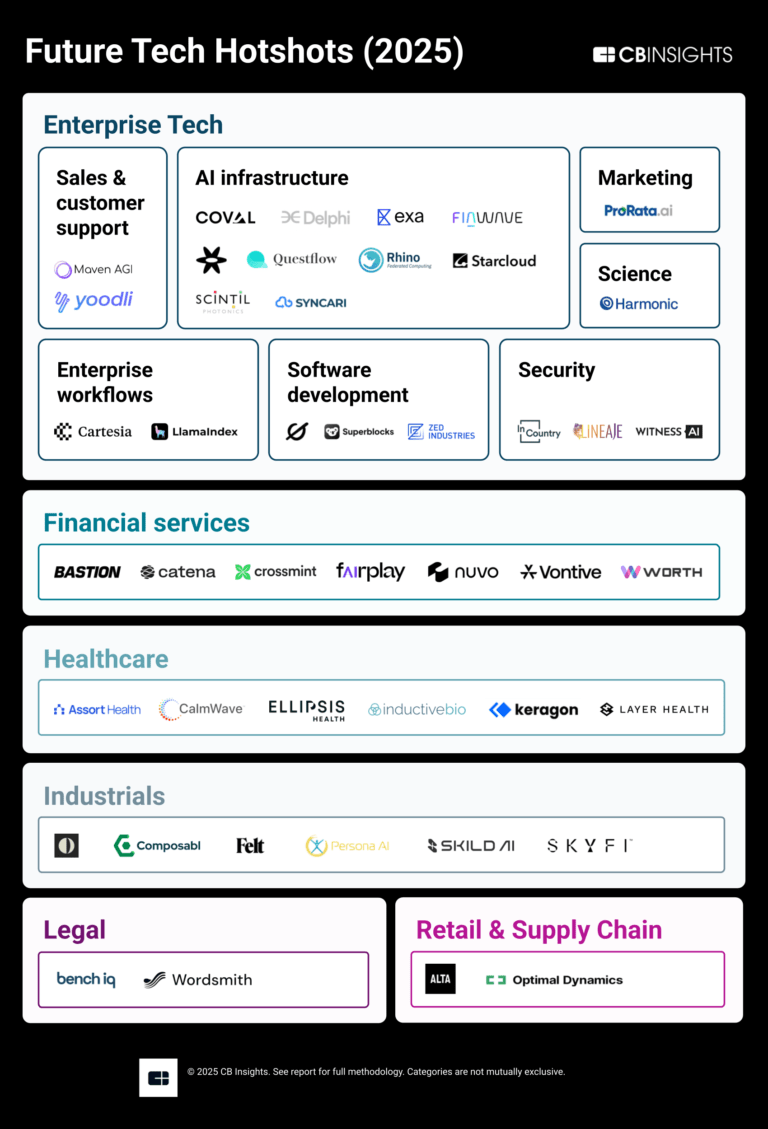
Future Tech Hotshots 2025
45 items
Latest Harmonic News
Oct 20, 2025
AI is the new electricity, but for CIOs, the real power lies not just in plugging into it, but in understanding the grid. Vendors will say they're “powered by AI.” But ask a few deeper questions, and you'll uncover a wide range of capabilities. Some built for lightweight automation, others trained to solve complex industry-specific challenges. So how can today's IT leaders separate signal from noise? How do you evaluate AI vendors not on their marketing but on their architecture, capabilities, and relevance to your enterprise? This piece focuses specifically on the enterprise software space where vendors are embedding AI into solutions that promise to optimize workflows, decisions, or business operations. It's not meant to catalog every category of AI technology, like robotics or computer vision. It offers a clear framework to help IT leaders distinguish what kind of AI they're actually buying and whether it's fit for purpose. Here's how to break it down. Four Technologies You Need to Know To make sense of what vendors are really selling, you need to understand the specific technologies they may be marketing as “AI”. Here we cover traditional approaches (statistical analysis and machine learning) which are still needed for certain use cases, and frontier technologies (LLMs and purpose-built AI) which are enabling new capabilities. What it is: Techniques involving business assumptions, liner models, seasonality analysis Example Use Cases: Credit and interest rate models Pricing elasticity analysis in retail Market impact analysis for hedge funds Best for: When causality or compliance are critical. Example Vendors: SAS – widely used in finance and healthcare for structured statistical modeling MathWorks (MATLAB) – advanced modeling in engineering and quantitative finance What it is: Prediction or classification models trained on structured numerical data—classification, clustering, and prediction models. Example Use Cases: Predictive maintenance in manufacturing Ad ranking systems at Google, Meta, Bing Quantitative finance models for high frequency trading Best for: Structured datasets where historical patterns drive future outcomes. Example Vendors: DataRobot Dataiku H2O.ai – AutoML and predictive analytics platforms Palantir C3.ai – Enterprise AI platforms for defense, energy, manufacturing Note that many vendors in this space are also pivoting to offering enterprise implementations of LLM agents, as discussed in the next section. What it is: Neural networks trained on large unstructured data, such as text, image, or video. Example Use Cases: Generating emails, reports, or product descriptions Agents for workflow automation, such as customer support Code generation Best for: Automating communication, classification, or recognition in unstructured data. Example Vendors: Language model providers: Anthropic (Claude), OpenAI (ChatGpt) Google (Gemini) Domain specific applications: Cursor (code generation), Sierra (customer support), Harvey (legal documents) What it is: Advanced models designed to solve industry-specific problems in search, optimization, and prediction Example Use Cases: Multi-echelon supply chain planning Demand forecasting, for physical goods, software, or financial assets Drug discovery for pharmaceutical companies Best for: Complex, high-dimensional problems where human intuition, statistical extrapolation, or LLMs, fall short, and algorithmic innovation is required Example Vendors: Omnifold AI – purpose-built AI for enterprise supply chain forecasting & optimization Isomorphic Labs –purpose-built AI for drug discovery Harmonic - purpose-built AI for formal mathematics To navigate this stack and spot the pretenders, ask these three questions: Who Trained the Model? If a vendor didn't train their own model, they're likely repackaging someone else's capabilities (often OpenAI or Anthropic). That's not inherently bad, but it limits customization. What Data Was It Trained On? Generic internet data is great for customer service, workflow automation, or document understanding, but won't at all help with optimizing your inventory, logistics, or drug discovery. Ask if the model can be trained, or fine-tuned, on your enterprise's unique data sets and objectives. What Was the Model Trained to Do? Was the model built to chat? To generate text? Even if the model is fine-tuned on your data, if the model's training objective doesn't match yours, you'll never get the outcomes you need. An ML model can't be a chatbot, and an LLM can't forecast complex demand patterns. AI transformation requires you to move beyond buzzwords and into architecture. It's not about buying AI, It's about building the right relationship with AI: one that fits your strategy, your data, and your ambitions. Here's a next step: Share this framework with your C-suite. Invite your vendors into a deeper conversation; not about features, but about fit. Elevate your teams' understanding. And, if you're ready, build a coalition with a partner who can train a model that's uniquely yours AI won't transform your business. You will: when you bring together the right people, ask the right questions, and architect a solution built not just for your problems, but for your potential.
Harmonic Frequently Asked Questions (FAQ)
When was Harmonic founded?
Harmonic was founded in 2023.
Where is Harmonic's headquarters?
Harmonic's headquarters is located at Palo Alto.
What is Harmonic's latest funding round?
Harmonic's latest funding round is Series B.
How much did Harmonic raise?
Harmonic raised a total of $175M.
Who are the investors of Harmonic?
Investors of Harmonic include Sequoia Capital, Index Ventures, Paradigm, Charlie Cheever, Ribbit Capital and 11 more.
Who are Harmonic's competitors?
Competitors of Harmonic include Asteromorph.
Loading...
Compare Harmonic to Competitors

Lila Sciences focuses on scientific discovery through its scientific superintelligence platform within the life, chemical, and materials sciences domains. The company offers a platform that integrates AI with autonomous laboratories to design, conduct, observe, and redesign experiments, aiming to produce new scientific knowledge at a significant scale and accuracy. Lila Sciences primarily serves sectors that require scientific research and development capabilities. It was founded in 2022 and is based in Cambridge, Massachusetts.

Sakana AI focuses on developing artificial intelligence (AI) through nature-inspired foundation models within the research and development sector. Its main offering includes creating a new kind of foundation model that draws inspiration from natural intelligence, designed to advance the field of AI. It was founded in 2023 and is based in Tokyo, Japan.
Asteromorph develops a superintelligence within the technology sector. The company provides an artificial intelligence foundation model that emulates the intuitions of scientists to assist in developing scientific statements through experiments. It serves sectors that utilize AI for scientific discovery and knowledge. It was founded in 2025 and is based in Seoul, South Korea.
Loading...