

Archetype AI
Founded Year
2023Stage
Incubator/Accelerator - III | AliveTotal Raised
$13MMosaic Score The Mosaic Score is an algorithm that measures the overall financial health and market potential of private companies.
-49 points in the past 30 days
About Archetype AI
Archetype AI is focused on developing a foundation model that understands and interacts with the physical world. Their product, Newton, processes multimodal sensor data and natural language to provide insights and predictions about physical environments. Newton integrates various sensors and customizes applications with proprietary data for specific tasks. It was founded in 2023 and is based in Palo Alto, California.
Loading...
ESPs containing Archetype AI
The ESP matrix leverages data and analyst insight to identify and rank leading companies in a given technology landscape.
The multimodal AI developers market provides foundation models and APIs that process and generate content across multiple modalities including text, images, audio, and video. These companies develop transformer-based architectures and vision-language models that enable simultaneous understanding and generation across different data types. Solutions include text-to-image generation, image-to-video …
Archetype AI named as Challenger among 15 other companies, including OpenAI, Microsoft, and Amazon.
Loading...
Research containing Archetype AI
Get data-driven expert analysis from the CB Insights Intelligence Unit.
CB Insights Intelligence Analysts have mentioned Archetype AI in 3 CB Insights research briefs, most recently on Oct 20, 2025.

Oct 20, 2025 report
Book of Scouting Reports: 2025’s Digital Health 50
May 16, 2025 report
Book of Scouting Reports: 2025’s AI 100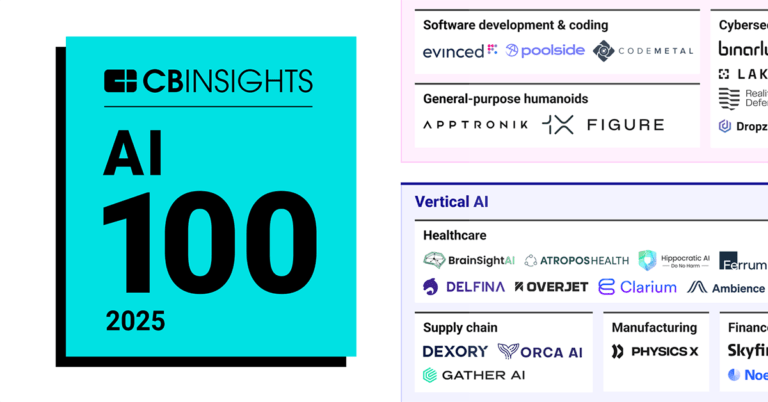
Apr 24, 2025 report
AI 100: The most promising artificial intelligence startups of 2025Expert Collections containing Archetype AI
Expert Collections are analyst-curated lists that highlight the companies you need to know in the most important technology spaces.
Archetype AI is included in 4 Expert Collections, including Artificial Intelligence (AI).
Artificial Intelligence (AI)
37,168 items
Companies developing artificial intelligence solutions, including cross-industry applications, industry-specific products, and AI infrastructure solutions.
Generative AI
2,951 items
Companies working on generative AI applications and infrastructure.
AI 100 (2025)
100 items
AI 100 (All Winners 2018-2025)
100 items
Latest Archetype AI News
Oct 23, 2025
Industrial AI: The new frontier of AI innovation The dawn of a new world of artificial intelligence is upon us. Industrial AI is transforming how mission critical systems, from transformers to traffic management, are developed, deployed, and automated. In this series, Hitachi provides a front row seat to the transformative power of Industrial AI. Sponsored by Hitachi Digital BrandPost By Joe Mullich Credit: iStock, Devrimb The AI startup frenzy is anything but hype. The first half of 2025 saw global investment in AI startups shoot to more than $205 billion , according to Crunchbase, with $145 billion raised in North America alone. And though observers may argue over their long-term viability, no one disputes the seemingly endless tsunami of new companies entering the fray. Some estimates put the number of AI startups globally at more than 10,000, with more than 5,000 emanating from the U.S. All this activity only adds to the pressures of the venture firms trying to determine which companies have the tech and teams to develop and market the next great breakthrough. But for the investment groups focused on a small but growing corner of the market – industrial AI – the stakes are even higher. Unlike “traditional” AI that may take the form of a human resources chatbot, or a marketing forecasting dashboard, industrial AI is the application of models and automation in mission-critical systems within energy, transportation, manufacturing, financial, healthcare, and the like. Issues common to enterprise-grade AI, like hallucinations, drift, biases, etc., are not tolerated in industrial AI. As such, selecting the right startups with whom to invest in this crazy environment is tough. “The fervor and volatility of the AI startup landscape presents a perfect storm for VCs, really,” says Gayathri Radhakrishnan, a partner at Hitachi’s investment arm, Hitachi Ventures. “You start by applying the myriad concerns you have with all startups, like cashflow, business structure, vision, team make-up, IP, etc. Simultaneously, you have to consider the chaos swirling around AI. And then on top of it all, you have to put on the industrial lens and ask, can these guys make it?” For Hitachi Ventures, which invests in firms across the technology spectrum, due diligence in the AI space requires a focused vision on the sector that best aligns with its business. What an industrial AI investment looks like That, however, can be easier said than done. The explosion of AI startups has created challenges reminiscent of the cloud computing hype cycle in the early 2010s. “When cloud became popular, every company claimed to be a cloud company,” Radhakrishnan says. “Today, every company claims to be an AI company. We must cut through the noise to understand whether AI is core to their mission or just a feature.” By 2023, the challenge of selecting AI investments only intensified as capital poured into general-purpose foundation models, like ChatGPT. “The space was quite crowded and even early-stage Series A funding rounds got quite expensive,” she says. Looking for a promising but less saturated niche and one that aligned best with Hitachi’s heritage in operation technology (OT) and information technologies (IT), as well as its deep expertise in AI, Hitachi Ventures turned its attention toward AI for industrial and physical environments. Gaining originality in modeling One of its early investments is Archetype AI Inc., a Palo Alto startup that is building a foundational AI model that interprets data from sensors – including sound, vibration, temperature, and pressure – to perceive, understand, and reason about the physical world. The company’s ultimate goal is to encode the entire physical world, which would enable it to predict equipment failures, optimize industrial processes, and create digital twins of real-world operations. Hitachi backed Archetype in December 2023, just seven months after the startup incorporated – an unusually early stage for venture investment – and well before physical AI started to become a mainstream investment. The fact that Archetype AI was pushing boundaries made it both promising and risky, a common balancing act for industrial AI investors. “What Archetype is doing is squarely in our thesis, but there was nobody else doing what they were doing at that time,” Radhakrishnan says. “We were a little uncomfortable because of that, but we were also comfortable with being uncomfortable. Sometimes the investments that could be the big winners have no precedent.” As a corporate venture fund, with Hitachi as its sole limited partner, Hitachi Ventures operates with twin objectives. “Our first responsibility is to deliver strong returns,” Radhakrishnan explains. “But we also want to create a broad, strategic advantage for Hitachi.” This means the firm’s deep dives into emerging technology spaces serve multiple purposes, including identifying investment opportunities while also educating the broader Hitachi organization about market trends. “Startups are often early indicators of technology waves,” she notes. “They’re a lighthouse that illuminates what’s coming in the distance.” Achieving cognitive resonance Hitachi Ventures’ investment in Xaba Inc ., illustrates this dual approach. The Toronto-based startup develops cognitive control systems for robotics, enabling machines to respond intelligently to their environment in real-time. Traditional robots are pre-programmed for specific tasks; if they encounter an obstruction, they either stop or push through it. Xaba’s xCognition technology, which combines physics-based modeling with AI learning, enables robots to perceive obstacles and automatically adjust their path, essentially acting like a “brain” for the robot. This allows the robot to reason, adapt, and generalize across tasks. What convinced Radhakrishnan wasn’t just the technology, but the Xaba founder’s depth of expertise, one of the many nuances that goes into funding decisions. “VCs are jacks of all trades who know everything, but who only know it an inch deep,” she says. “The founder comes with a strong technical background combined with industry knowledge, and he understands his space really well.” When Radhakrishnan introduced the xCognition technology to counterparts at Hitachi Rail Ltd., they immediately saw its value. The Hitachi subsidiary, which operates in more than 50 countries, is now deploying Xaba’s robots for precision machining on the surfaces of locomotives. These tasks require sub-millimeter accuracy that previously demanded extensive manual labor. But the Xaba team didn’t stop there. While AI co-pilots are all the rage for coding, Xaba has developed an automated code generator for Programmable Logic Controller (PLC), called PLCfy, that enables democratization of industrial automation. PLCfy provides a drop-in AI layer that augments existing PLCs with modern capabilities, like predictive control, anomaly detection, and adaptive optimization, without ripping and replacing hardware. The flip side of consensus Yet while Xaba seems like the ideal Hitachi Ventures’ investment, it also demonstrates how challenging the industrial AI space is: Initially, the partners in the firm’s investment committee couldn’t agree whether it was worth pursuing. “Sometimes when you can’t get consensus, those are the deals where you think, ‘Maybe there’s something there,’ ” she says. “Who would have thought that an online company selling books would redefine global compute needs? Or that a social media company connecting friends would impact enterprise storage buying behavior? If the impact of an AI startup is obvious to everyone, you’re probably not investing in the next Google, Amazon, or Facebook.” # # # Gayathri Radhakrishnan is a partner at Hitachi Ventures. With more than $1B AUM, the company is setting new standards for corporate ventures, fostering partnership and access for ambitious founders transforming the world around us. From advanced AI and robotics to sustainable energy solutions and beyond, Hitachi Ventures sees the potential in investing in companies that dare to dream big and disrupt the status quo. The firm’s expertise, coupled with Hitachi’s global resources and commitment to innovation, enables it to identify and nurture promising startups with the potential to drive significant impact and shape the future of technology.
Archetype AI Frequently Asked Questions (FAQ)
When was Archetype AI founded?
Archetype AI was founded in 2023.
Where is Archetype AI's headquarters?
Archetype AI's headquarters is located at 3340 Hillview Avenue, Palo Alto.
What is Archetype AI's latest funding round?
Archetype AI's latest funding round is Incubator/Accelerator - III.
How much did Archetype AI raise?
Archetype AI raised a total of $13M.
Who are the investors of Archetype AI?
Investors of Archetype AI include AWS Generative AI Accelerator, Plug and Play Ventures, Amazon Industrial Innovation Fund, Venrock, Buckley Ventures and 5 more.
Loading...
Loading...