

AI21 Labs
Founded Year
2017Stage
Series D | AliveTotal Raised
$617MLast Raised
$300M | 6 mos agoRevenue
$0000Mosaic Score The Mosaic Score is an algorithm that measures the overall financial health and market potential of private companies.
+48 points in the past 30 days
About AI21 Labs
AI21 Labs develops artificial intelligence systems and foundation models within the technology sector. The company offers generative AI solutions for enterprise workflows, including products like the engine for conversational AI and deployment options. It serves sectors that require AI integration, including financial technology, research, and business operations. It was founded in 2017 and is based in Tel-Aviv, Israel.
Loading...
AI21 Labs's Product Videos
ESPs containing AI21 Labs
The ESP matrix leverages data and analyst insight to identify and rank leading companies in a given technology landscape.
The large language model (LLM) developers market offers foundation models and APIs that enable enterprises to build natural language processing applications for multiple functions. These include content creation, summarization, classification, chat, and sentiment analysis. Companies in this market develop and train their own large-scale language models — which are pre-trained on vast amounts of te…
AI21 Labs named as Challenger among 15 other companies, including Google, IBM, and NVIDIA.
Loading...
Research containing AI21 Labs
Get data-driven expert analysis from the CB Insights Intelligence Unit.
CB Insights Intelligence Analysts have mentioned AI21 Labs in 10 CB Insights research briefs, most recently on Sep 5, 2025.
Sep 5, 2025 report
Book of Scouting Reports: The AI Agent Tech Stack
Aug 29, 2025 report
Book of Scouting Reports: Generative AI in Financial Services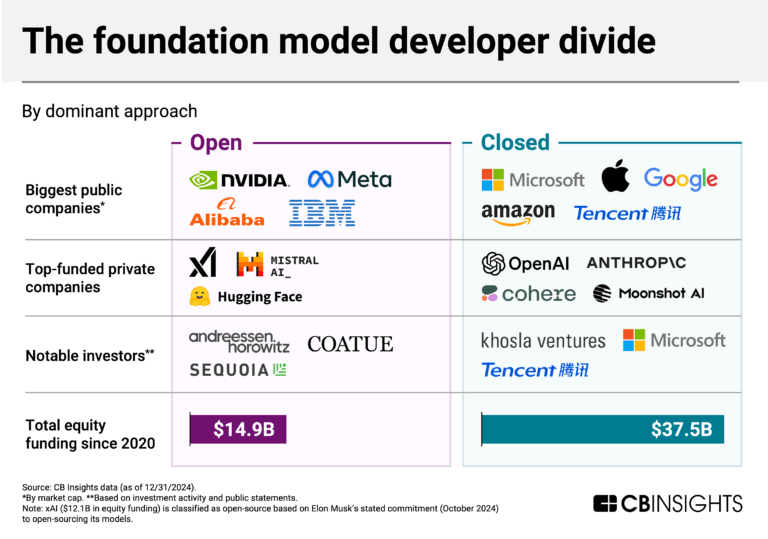
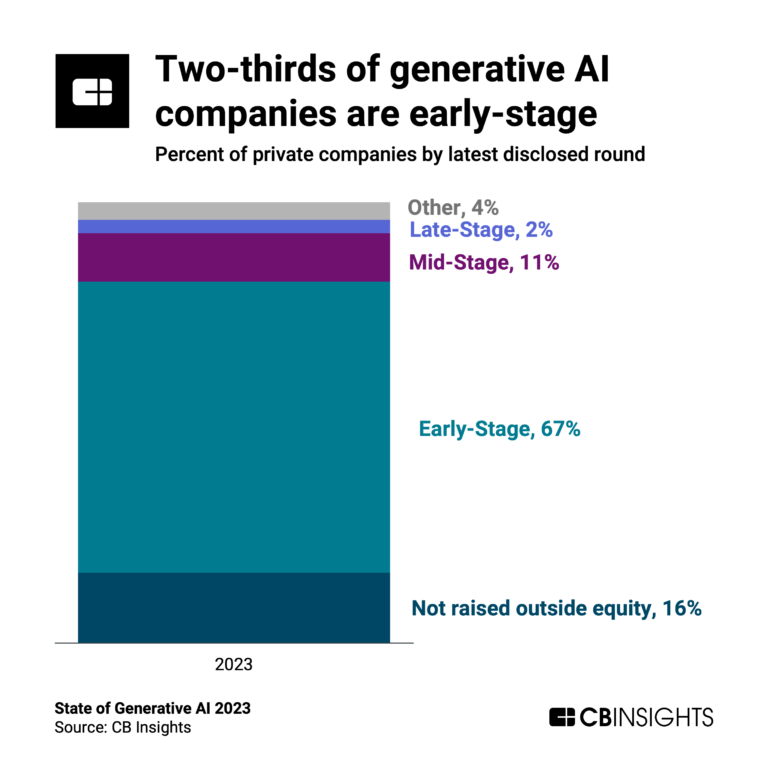
Feb 27, 2024
The generative AI boom in 6 charts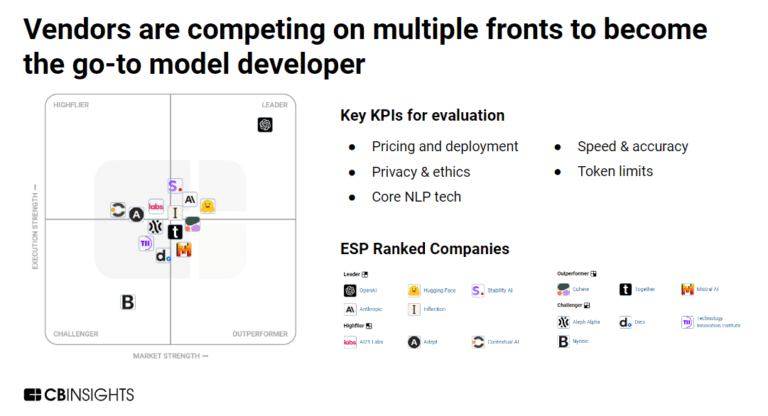

Nov 15, 2023 report
State of AI Q3’23 Report
Oct 12, 2023 report
State of Venture Q3’23 ReportExpert Collections containing AI21 Labs
Expert Collections are analyst-curated lists that highlight the companies you need to know in the most important technology spaces.
AI21 Labs is included in 6 Expert Collections, including Unicorns- Billion Dollar Startups.
Unicorns- Billion Dollar Startups
1,297 items
Artificial Intelligence (AI)
25,729 items
Companies developing artificial intelligence solutions, including cross-industry applications, industry-specific products, and AI infrastructure solutions.
Digital Content & Synthetic Media
2,287 items
The Synthetic Media collection includes companies that use artificial intelligence to generate, edit, or enable digital content under all forms, including images, videos, audio, and text, among others.
AI 100 (All Winners 2018-2025)
200 items
Generative AI 50
50 items
CB Insights' list of the 50 most promising private generative AI companies across the globe.
Generative AI
2,951 items
Companies working on generative AI applications and infrastructure.
AI21 Labs Patents
AI21 Labs has filed 19 patents.
The 3 most popular patent topics include:
- computational linguistics
- natural language processing
- tasks of natural language processing
Application Date | Grant Date | Title | Related Topics | Status |
|---|---|---|---|---|
5/11/2023 | 2/18/2025 | Natural language processing, Computational linguistics, Tasks of natural language processing, Semantics, Artificial intelligence applications | Grant |
Application Date | 5/11/2023 |
|---|---|
Grant Date | 2/18/2025 |
Title | |
Related Topics | Natural language processing, Computational linguistics, Tasks of natural language processing, Semantics, Artificial intelligence applications |
Status | Grant |
Latest AI21 Labs News
Oct 15, 2025
Called “nanochat,” the open-source project, released yesterday for his AI education startup EurekaAI, shows how anyone with a single GPU server and about $100 can build their own mini-ChatGPT that can answer simple questions and write stories and poems. Karpathy, who called nanochat a “micro model,” wrote on X that models like his should be thought of as “very young children” that “don't have the raw intelligence of their larger cousins.” Scale up your spending to $1,000, however, and such a model “quickly becomes a lot more coherent and can solve simple math/code problems and take multiple choice tests.” The announcement garnered millions of views on X, with the CEO of Shopify , Tobi Lutke, calling it a “gift” to developers, researchers and students. But it's also an example of what has become a growing trend: smaller, cheaper and more specialized models that have fewer parameters, or the “knobs” inside a model that get fine-tuned during training to help it make sense of language, images, or data. Massive large language models (LLMs) may have trillions of parameters, requiring access to GPUs in the cloud and enormous computational power, while the latest small models may have just a few billion parameters. With fewer parameters, these small models don't try to match the power of frontier models like GPT-5, Claude, and Gemini. But they are good enough for specific tasks, affordable to train, lightweight enough to use on devices like phones and laptops, and easy for startups, researchers, and hobbyists to build and deploy. The small-model approach was echoed by researchers at Samsung AI Lab last week, who released a paper showing off their Tiny Recursive Model. It uses a new neural network architecture that shows remarkable efficiency on complex reasoning and puzzle tasks like Sudoku, outperforming popular LLMs while using a minuscule fraction of the computational resources. There has been a wave of other organizations releasing small AI models, showing that size isn't everything when it comes to power. Last week, Israel's AI21 unveiled Jamba Reasoning 3B, a 3-billion-parameter open source model that can “remember” and reason over massive amounts of text, and run at high speed even on consumer devices. In September, UAE's Mohamed bin Zayed University of Artificial Intelligence (MBZUAI) and G24 recently introduced K2 Think, an open-source reasoning model with only 32 billion parameters that in trials rivaled systems more than 20 times as large. Meanwhile, big tech companies like Google Microsoft IBM and OpenAI have all joined the small-but-mighty club, with models that are a fraction of the size of their bigger counterparts. Much of this momentum traces back to China's DeepSeek, whose lean, low-cost models upended industry assumptions at the beginning of this year and kicked off a race to make AI smaller, faster, and smarter. But it's important to note that these models, while impressive, aren't designed to match the broad capabilities of frontier systems like GPT-5. Instead, they're built for narrower, specialized tasks—and often shine in specific use cases. For example, this week IBM Research, along with NASA and others, released open-source, “drastically smaller” versions of its Prithvi and TerraMind Earth-observation models that can run on almost any device, from satellites orbiting Earth to the smartphone in your pocket, all while maintaining strong performance. “These models could reshape how we think about doing science in regions far from the lab—whether that's in the vacuum of space or the savanna,” the company wrote in a blog post. None of this means the era of massive, trillion-parameter models is coming to an end. As companies like OpenAI, Google and Anthropic push for artificial general intelligence, which requires more reasoning capabilities, those will be the models that push the frontier. But the rise of smaller, cheaper, and more efficient models shows that AI's future won't be defined by size alone. Paid Content AI is surging—here's how our energy systems keep up From Iberdrola About the Author Sharon Goldman AI Reporter Sharon Goldman is an AI reporter at Fortune and co-authors Eye on AI Fortune 's flagship AI newsletter. She has written about digital and enterprise tech for over a decade. SEE FULL BIO Sponsored Stories
AI21 Labs Frequently Asked Questions (FAQ)
When was AI21 Labs founded?
AI21 Labs was founded in 2017.
Where is AI21 Labs's headquarters?
AI21 Labs's headquarters is located at 124 Shlomo Ibn Gabirol Street, Tel-Aviv.
What is AI21 Labs's latest funding round?
AI21 Labs's latest funding round is Series D.
How much did AI21 Labs raise?
AI21 Labs raised a total of $617M.
Who are the investors of AI21 Labs?
Investors of AI21 Labs include NVIDIA, Google, Ahren, Intel Capital, Comcast Ventures and 16 more.
Who are AI21 Labs's competitors?
Competitors of AI21 Labs include OpenAI, Mistral AI, Distyl AI, Anthropic, Convergence and 7 more.
Loading...
Compare AI21 Labs to Competitors

One AI specializes in generative artificial intelligence (AI) within the technology sector. The company offers services such as language analytics, customizable AI skills, and the processing of text, audio, and video data into structured, actionable insights. It primarily serves sectors such as customer service, e-commerce, media, healthcare, and government. It was founded in 2021 and is based in San Francisco, California.

Cohere operates as an enterprise artificial intelligence (AI) company building foundation models and AI products across various sectors. The company offers a platform that provides multilingual models, retrieval systems, and agents to address business problems while ensuring data security and privacy. Cohere serves financial services, healthcare, manufacturing, energy, and the public sector. It was founded in 2019 and is based in Toronto, Canada.

Hugging Face operates as an open-source machine learning platform focused on artificial intelligence within the technology sector. The company provides a space for the machine learning community to develop models, share datasets, and host artificial intelligence (AI) applications, and offers enterprise solutions. Hugging Face was formerly known as Hugging Face. It was founded in 2016 and is based in Paris, France.

Sakana AI focuses on developing artificial intelligence (AI) through nature-inspired foundation models within the research and development sector. Its main offering includes creating a new kind of foundation model that draws inspiration from natural intelligence, designed to advance the field of AI. It was founded in 2023 and is based in Tokyo, Japan.

Inflection AI focuses on enterprise artificial intelligence, providing artificial intelligence (AI) model training and tuning while addressing data security and cost efficiency for enterprise clients. The company's solutions integrate into business operations. It was founded in 2022 and is based in Palo Alto, California.

Fireworks AI is a company that provides a generative AI platform as a service within the technology sector. The company focuses on product iteration and cost reduction for its clients. It was founded in 2022 and is based in Redwood City, California.
Loading...